
El Niño Poised for Record Strength, Threatening Global Food Prices
Translated & summarized from Bizportal by baba
The current El Niño event is strengthening and is forecast to be one of the most powerful on record, with an 83% probability. Historically, El Niño has caused significant global economic damage through extreme weather, impacting food prices, energy costs, and shipping. Past events, like those in 1997-1998 and 2015-2016, led to widespread droughts, fires, and billions in damages, while the recent Panama Canal drought highlights ongoing trade disruptions. Experts warn of potential global food commodity price increases of up to 9% due to this phenomenon.
The story in 6 lines · by baba
- The current El Niño is forecast to be one of the strongest on record with an 83% probability.
- El Niño events historically cause billions in damages through droughts, floods, and supply chain disruptions.
- The 1997-1998 El Niño caused massive fires in Indonesia, damaging 8 million hectares and costing up to $20 billion.
- The 2015-2016 El Niño resulted in $16.1 billion in damages from fires in Indonesia and reduced monsoon rains in India.
- Recent El Niño impacts include reduced shipping capacity through the Panama Canal by nearly 40%.
- A strong El Niño could increase global food commodity prices by up to 9%, affecting import-reliant nations like Israel.
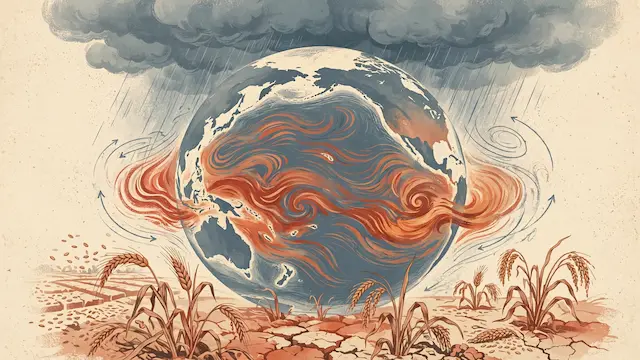
New forecasts indicate that the current El Niño event in the Pacific Ocean may become one of the strongest on record, with an 83% probability of exceeding previous measurements. While seemingly a distant phenomenon related to ocean temperatures, El Niño has historically impacted global food prices, electricity bills, and shipping costs, causing billions of dollars in damages through droughts and floods. This event arrives as the world already grapples with high energy prices and supply chain disruptions.
The current El Niño is projected to be significantly stronger than the 2015-2016 event. Water temperatures in a key Pacific region are expected to be about 3.7 degrees Celsius above average from October to December, compared to a 2.6-degree anomaly in 2015-2016. This intensified warming is expected to peak around December.
El Niño typically weakens the trade winds that push warm Pacific waters west, allowing them to spread east. This shift can lead to droughts in places like Indonesia and Australia, while causing heavy rainfall in parts of South America. The 1997-1998 El Niño, a powerful event, caused severe flooding in Peru and Ecuador and a devastating drought in Indonesia, where fires burned an area eight times the size of Israel, resulting in economic damages estimated between $4.5 billion and $20 billion.
Similarly, the 2015-2016 El Niño caused widespread fires in Indonesia, damaging 2.6 million hectares and costing $16.1 billion. In India, monsoon rains were 14% below average, impacting agricultural economies. More recently, the 2023-2024 El Niño contributed to a drought in Panama, significantly reducing water levels in Gatun Lake and cutting daily ship transits through the Panama Canal by nearly 40%, impacting global trade.
The impact on food prices is a major concern. Cocoa prices, for instance, surged 175% in 2024 due to a combination of factors including El Niño's influence on weather in West Africa, leading to price increases for chocolate products. This price transmission to consumers is gradual, affecting goods like rice, sugar, coffee, and palm oil. A strong El Niño could increase global food commodity prices by up to 9%, though this is an estimate based on past correlations and doesn't directly translate to consumer price hikes. Israel, heavily reliant on imports for staples like coffee, cocoa, sugar, grains, and oils, is particularly exposed to these fluctuations, which are also influenced by shipping costs and the shekel's exchange rate. Central banks are concerned that rising food and energy prices could hinder inflation reduction efforts amid a weakening economy.
The same event, reported separately by each outlet. Open a few to compare what different newsrooms emphasize — and what they leave out.
Centre 1Other 1

Not the same event — other stories that share this one’s people, places, or theme: background, reactions, and follow-ups.
