
Gaza's Healthcare System Remains Crippled a Year After Ceasefire
Translated & summarized from Local Call by baba
A year after a ceasefire, Gaza's healthcare system remains severely crippled with no fully operational hospitals, critical shortages of medicine and equipment, and thousands of patients unable to receive necessary treatment. Physicians for Human Rights reports that conditions have worsened in some areas, with Israel blocking essential supplies and rehabilitation services. Since October 2025, over 1,400 people have been killed and thousands injured, while medical evacuations have drastically decreased.
The story in 5 lines · by baba
- No hospitals in Gaza are fully operational a year after a ceasefire, facing critical shortages of medicine and equipment.
- Thousands of patients cannot leave Gaza for treatment, and Israel is blocking prosthetics and rehabilitation services.
- Since October 2025, at least 1,445 people have been killed and 5,227 injured in Gaza.
- Medical evacuations from Gaza have drastically decreased, with only about 3,423 patients evacuated in the past year.
- Physicians for Human Rights states Israeli authorities are responsible for creating conditions aimed at destroying Gaza's population.
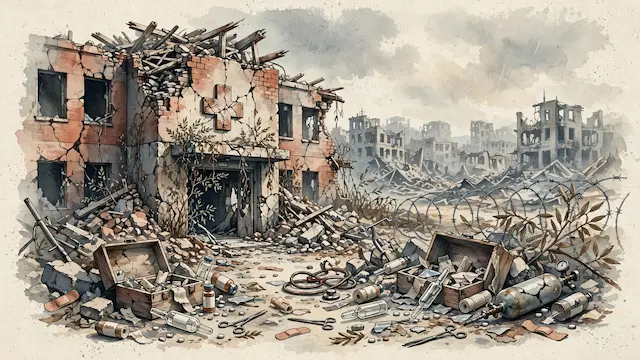
A year after a ceasefire took effect in Gaza, no hospitals in the Strip are fully operational, according to a new position paper by Physicians for Human Rights. Critical shortages of medicine, equipment, and essential medical services persist, and in some cases have worsened. Thousands of patients remain unable to leave Gaza for treatment unavailable locally, indicating that the ceasefire has not initiated a recovery process for residents.
Despite an increase in the number of active hospitals from 14 to 20 over the past year, all are functioning partially. They cannot provide comprehensive care according to protocols. The report highlights that Israel prevents the entry of prosthetics and the establishment of rehabilitation systems for new amputees, including many children, who are often living in dire conditions in tents.
Humanitarian organizations have reported difficulties in bringing even basic supplies like sterile gauze and disinfectants into Gaza. At times, there have been shortages of dialysis equipment, insulin, and colostomy bags, with syringes running out at Al-Nasser Hospital in early January 2026. No functioning MRI machines are available, delaying diagnoses.
Since October 2025, at least 1,445 people have been killed and 5,227 injured in Gaza. The waiting list for evacuation for medical treatment via the World Health Organization continues to grow. In the past year, only about 3,423 patients were evacuated for treatment in third countries, mostly to Egypt, a stark contrast to the approximately 3,000 patients who left Gaza monthly for essential care before October 7, 2025.
Physicians for Human Rights filed a petition in November 2025 demanding the reopening of the medical corridor between Gaza and the West Bank, including East Jerusalem. The paper criticizes the state and the courts for placing the responsibility for patient evacuation on third countries, while citing security concerns as justification for the broad ban on patient movement from Gaza to the West Bank without individual case reviews. The organization previously determined in July 2025 that Israeli authorities were responsible for intentionally creating living conditions aimed at the destruction of Gaza's population, a reality that has not changed despite the ceasefire.
Mentioned
The same event, reported separately by each outlet. Open a few to compare what different newsrooms emphasize — and what they leave out.
Left 1Arab 2


Not the same event — other stories that share this one’s people, places, or theme: background, reactions, and follow-ups.