Gaza Hospitals Remain Crippled One Year After Ceasefire, Rights Group Reports
Translated & summarized from Alarab by baba
A report by Physicians for Human Rights reveals that Gaza's healthcare system remains severely crippled one year after a ceasefire, with no hospitals operating at full capacity. Critical care beds have barely increased, and essential medical supplies face severe shortages, with 69% of approved items not reaching Gaza. The report also details ongoing attacks on healthcare and the deaths of over 1,570 patients awaiting evacuation, attributing the continued crisis to Israeli policies.
The story in 6 lines · by baba
- No hospitals in Gaza are fully operational one year after a ceasefire, according to Physicians for Human Rights.
- Intensive care beds increased by only one, from 103 to 104, between October 2025 and July 2026.
- 69% of medical supplies approved for entry into Gaza between January and May 2026 did not arrive.
- At least 1,570 patients died awaiting medical evacuation between October 2023 and July 2026.
- The rate of medical evacuations is three to six times lower than pre-war levels.
- Physicians for Human Rights claims Israeli policies continue to hinder recovery and prevent survival in Gaza.
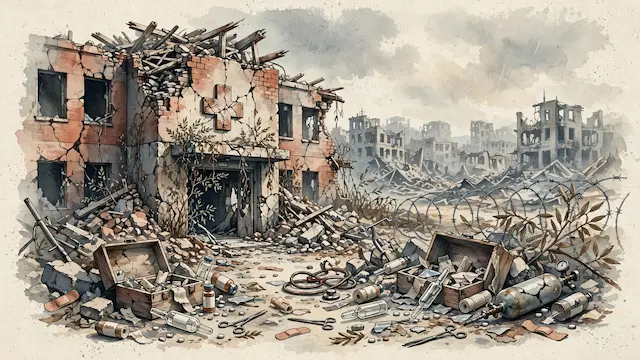
A year after a ceasefire was declared, not a single hospital in Gaza is operating at full capacity, according to a new report by Physicians for Human Rights. The report, which compares the situation before October 2023 to the present, indicates that the healthcare system has not recovered and has even deteriorated in critical areas. While the number of partially functioning hospitals increased from 14 to 20, none are fully operational.
Critical care capacity has seen minimal improvement, with the number of intensive care beds rising from 103 to only 104 between October 2025 and July 2026. Kidney dialysis services have also declined, available in only 12% of health facilities compared to 17% previously, and MRI services remain unavailable. The report highlights that 69% of medical supplies approved for entry into Gaza between January and May 2026 never arrived.
During the seven months following the ceasefire's announcement, the World Health Organization documented at least 143 additional attacks on healthcare facilities. Furthermore, the report states that between October 2023 and July 2026, at least 1,570 patients died while awaiting medical evacuation, including 505 cancer patients and 264 children. The rate of medical evacuations has also significantly decreased, three to six times lower than pre-war levels, despite a substantial increase in the need for treatment outside the Strip.
Physicians for Human Rights asserts that Israel continues to restrict the entry of medical supplies and prevent patients from accessing treatment outside Gaza, hindering the healthcare system's rehabilitation. The organization argues that actions previously classified as part of genocide, including imposing living conditions calculated to destroy the Palestinian population, have continued during the ceasefire. Milena Ansari, the report's author, stated that the ceasefire did not stop genocide but merely changed its methods, with Israeli policies continuing to prevent Palestinians in Gaza from surviving.
The organization is calling on Israel to reopen the medical corridor between Gaza and the West Bank, including East Jerusalem, lift restrictions on medical supplies and humanitarian workers, and allow for the rehabilitation of Gaza's healthcare system.
Mentioned
The same event, reported separately by each outlet. Open a few to compare what different newsrooms emphasize — and what they leave out.
Left 1Arab 2


Not the same event — other stories that share this one’s people, places, or theme: background, reactions, and follow-ups.