
Israel to Expand Services at Mobile and Partial Bank Branches
Translated & summarized from NEWSru Israel by baba
Starting January 2027, Israel's Bank of Israel will allow mobile and partial bank branches to offer a full suite of services, aiming to improve accessibility, especially in underserved areas. Restrictions on temporary branches are also being lifted, removing time limits and notification requirements. These changes come as digital banking transactions surge, though banks must still ensure in-person service for vulnerable populations. As of late 2025, Israel had 959 bank branches, with a growing number of partial and mobile units.
The story in 6 lines · by baba
- Mobile and partial bank branches in Israel will offer full services starting January 2027.
- Restrictions on temporary bank branches are being lifted, removing operational limits and notification rules.
- The Bank of Israel aims to improve banking accessibility in peripheral areas and for specific demographics.
- Digital banking transactions reached 90% in 2025, up from 66% in 2019.
- Banks must ensure in-person service access for the elderly, disabled, and digitally less literate.
- Israel had 959 bank branches at the end of 2025, with 57 being partial or mobile.
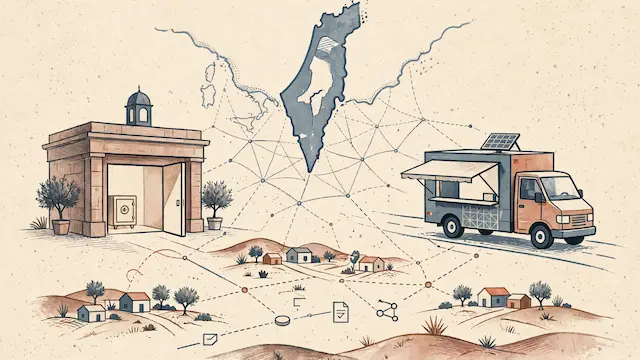
Starting in January 2027, the Bank of Israel will permit partial and mobile bank branches to offer a full range of services to all customers. Partial branches operate from a dedicated space with a bank sign, while mobile branches can relocate, including via vehicle. The Bank of Israel's supervision department noted that the experience with these branches has shown their utility, particularly in nursing homes and peripheral areas, enhancing access to banking services in locations with fewer traditional branches. Concurrently, restrictions on temporary branches, primarily used for attracting new clients, are being lifted. The 90-day operational limit and numerical cap on these branches will be removed, and banks with general authorization will no longer need to provide advance notice to supervisors for each new branch opening. However, the services offered at temporary branches will remain limited to account opening applications, deposits, loan and payment card applications, and document issuance. In 2025, approximately 90% of banking transactions were conducted through direct channels, a significant increase from 66% in 2019, with 65% of these occurring via bank applications. This digital shift contrasts with older demographics, as only 30% of transactions by customers aged 71 and older were through apps, compared to about 67% for customers under 25. In light of these trends, the banking supervision has updated its requirements for banks' branch network policies. Banks are now mandated to ensure adequate in-person service accessibility, considering the needs of the elderly, individuals with disabilities, residents of peripheral areas, the ultra-Orthodox and Arab sectors, and customers with low digital literacy. As of the end of 2025, Israel had 959 bank branches, including 902 permanent and 57 partial and mobile locations. Following a reduction that began in 2013, the number of branches has stabilized since 2021. Currently, only 32% of branches offer cash services, and 59% provide mortgage services.
The same event, reported separately by each outlet. Open a few to compare what different newsrooms emphasize — and what they leave out.
Other 2

Not the same event — other stories that share this one’s people, places, or theme: background, reactions, and follow-ups.
