
Israel to Expand Mobile and Temporary Bank Branches Offering Full Services
Translated & summarized from Calcalist by baba
Bank of Israel will allow mobile and partial bank branches to offer full services to all customers starting January 2027. Restrictions on temporary "pop-up" branches will also be removed, including operational time limits and quantity caps. These changes aim to improve banking accessibility, especially for vulnerable populations and those in underserved areas, as digital banking adoption rises. The move acknowledges the varying levels of digital engagement across different demographics.
The story in 6 lines · by baba
- Mobile and partial bank branches in Israel will offer full services to all customers from January 2027.
- Temporary "pop-up" bank branches will have restrictions on operational time and numbers removed.
- The changes aim to increase banking accessibility for diverse populations and peripheral areas.
- Approximately 90% of banking operations were conducted via direct channels in 2025.
- Digital banking adoption varies significantly among different age groups.
- Bank of Israel will update directives to ensure physical service points cater to specific demographic needs.
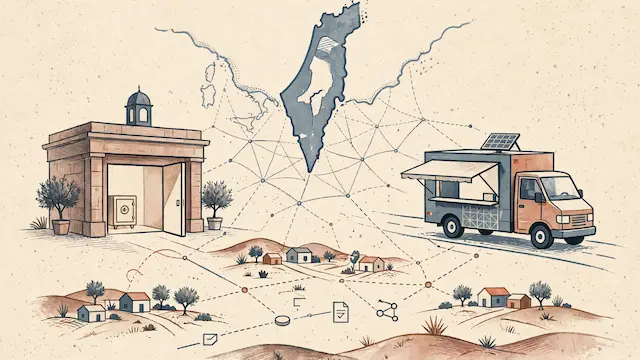
Starting January 2027, Bank of Israel is significantly expanding the services that banks can offer outside of their permanent branches. Mobile and partial branches, which currently have limitations on the types of customers and services they can provide, will be permitted to offer all banking services to all customers. Additionally, restrictions on temporary "pop-up" bank branches will be lifted, including the 90-day operational limit and a cap on their numbers. Banks with the appropriate general permit will no longer need to pre-notify the Supervisor of Banks before opening such a branch.
The new regulations distinguish between three types of service points. Temporary branches, or "pop-ups," are primarily for acquiring new customers and will remain limited to services like account opening, deposits, credit, debit cards, and document submission. In contrast, partial branches operate from a dedicated, signed bank space, and mobile branches are transportable service points, potentially in vehicles. The key innovation for partial and mobile branches is the removal of restrictions on services and customer types, allowing them to provide full banking services.
Bank of Israel noted that experience with partial and mobile branches has shown their benefit to diverse populations, including in nursing homes and peripheral areas, increasing access to banking in locations with limited branch presence. These changes come as public adoption of direct banking channels has reached a high level, with approximately 90% of banking operations conducted through these channels in 2025, up from 66% in 2019. While 65% of these direct operations were via bank apps, digital adoption varies significantly by age group.
To address the digital divide, the Supervisor of Banks is also reinforcing requirements for banks to establish branch policies that consider customer needs, demographics, and geographic distribution, ensuring adequate service alongside the shift to direct banking. This includes explicit consideration for the elderly, people with disabilities, residents of peripheral areas, the Haredi and Arab communities, and those with low digital literacy. Bank of Israel intends to update its banking management directive accordingly.
The number of bank branches in Israel has stabilized since 2021, with 959 branches operating at the end of 2025, including 902 permanent and 57 partial or mobile ones. However, not all branches offer the full range of traditional services, with teller services available in only about 32% and mortgage services in about 59%. The directive also cancels an old permit for relocating branches within 500 meters, as this is now covered by existing legal provisions.
The same event, reported separately by each outlet. Open a few to compare what different newsrooms emphasize — and what they leave out.
Other 2
