
Trump's Support for Netanyahu Could Cost Israel Dearly
תורגם ותומצת מתוך Cursorinfo על ידי baba
US President Donald Trump's strong backing of Israeli Prime Minister Benjamin Netanyahu is raising concerns about potential negative repercussions for Israel, especially if a future US administration has different interests. Trump's involvement in Netanyahu's campaign and security matters goes beyond typical strategic partnerships. Despite diplomatic gains like US recognition of the Golan Heights, this support could be used as leverage by future US leaders. Israel faces a political deadlock after recent elections and significant security threats, underscoring the need for a stable government.
הידיעה ב-5 שורות · תקציר של baba
- US President Donald Trump's active support for Benjamin Netanyahu is seen as potentially harmful to Israel's long-term interests.
- Trump's involvement in Netanyahu's campaign and security matters exceeds normal strategic partnership levels.
- Past US diplomatic gains under Trump include recognition of Golan Heights and embassy move to Jerusalem.
- Israel faces a political stalemate after elections, with no bloc securing a majority to form a government.
- The country is dealing with significant national security threats from Iran, Hamas, and Hezbollah.
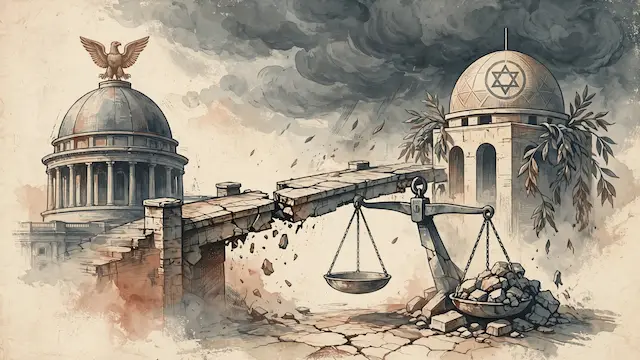
US President Donald Trump's active support for Prime Minister Benjamin Netanyahu is raising concerns that such backing could have unforeseen negative consequences for Israel. Trump has effectively entered the political fray on Netanyahu's behalf, acting as an influential international patron. This intervention is particularly significant given the political uncertainty in Israel following recent Knesset elections, where no single bloc secured a majority to form a government. Trump's involvement is seen as encompassing Netanyahu's election campaign, his potential pardon, and guarantees of regional security support. The article notes that this level of foreign leader involvement in domestic politics exceeds typical strategic partnerships.
Concerns are heightened by Trump's past statement that Netanyahu would follow his directives, which could be perceived as demeaning and indicative of political dependence on Washington. Despite these concerns, cooperation with Trump has yielded significant diplomatic gains for Israel, including US recognition of Israeli sovereignty over the Golan Heights, the relocation of the US embassy to Jerusalem, and joint efforts against Iran. However, the article cautions that support from the current US president does not guarantee alignment of interests with future administrations. A successor to Trump might employ similar tactics to pressure a different Israeli government.
The political stalemate is exacerbated by the election results, which left neither the Likud party nor its opponents with a clear parliamentary majority. The fragmentation within the "Change Bloc" and poor coordination are cited as reasons for their failure to gain a decisive advantage. Breaking this political deadlock may necessitate revising campaign promises, a move previously undertaken by Israeli leaders like Menachem Begin, Ariel Sharon, and Netanyahu himself under similar political pressures.
This prolonged political crisis unfolds against a backdrop of serious national security threats, including potential escalation with Iran, ongoing threats from Hamas and Hezbollah, and economic and diplomatic challenges. The article stresses the urgent need for a stable government capable of making decisions with broad public support, especially in the context of potential military actions where public trust in leadership is crucial for national resilience.
מוזכרים
לא אותו אירוע: ידיעות אחרות שחולקות עם הידיעה הזו אנשים, מקומות או נושא. רקע, תגובות והמשכים.


