
Ada Yonath, Nobel Laureate in Chemistry, Dies at 87
Nobel laureate Professor Ada Yonath, who revolutionized the understanding of ribosomes and their role in antibiotic resistance, has died at 87. Her pioneering work earned her the Nobel Prize in Chemistry in 2009, and she was a distinguished researcher at the Weizmann Institute of Science.
הידיעה ב-6 שורות · תקציר של baba
- Nobel laureate Professor Ada Yonath died at 87.
- She won the 2009 Nobel Prize in Chemistry for ribosome research.
- Her work advanced understanding of protein synthesis and antibiotic resistance.
- Yonath was a long-time researcher at the Weizmann Institute of Science.
- She faced initial skepticism but persevered in her research.
- She also spoke out on Israeli political issues.
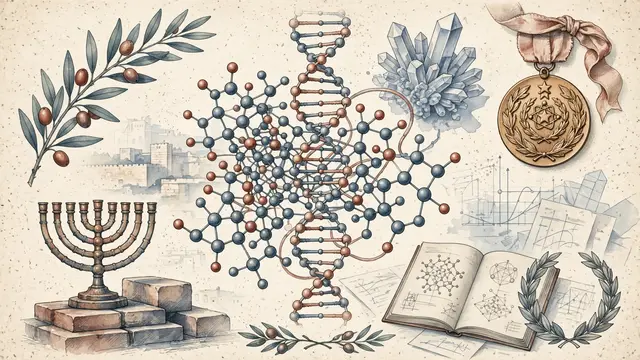
Professor Ada Yonath, a Nobel Prize laureate in Chemistry, passed away on Monday at the age of 87. Yonath was awarded the Nobel Prize in 2009 for her groundbreaking research on ribosomes, the cellular machinery responsible for protein synthesis. Her pivotal findings, presented in the mid-1990s, revolutionized the understanding of this fundamental biological process and opened new avenues for combating antibiotic resistance.
Born Ada Libshitz in Jerusalem in 1939, Yonath grew up in modest circumstances. After her father's death when she was 11, she contributed to the family's financial support through various jobs. The family later moved to Tel Aviv, where she attended high school. She served in the IDF's Medical Corps, an experience that sparked her interest in clinical and medical issues, leading her to study chemistry at the Hebrew University of Jerusalem. She completed her doctorate with honors at the Weizmann Institute of Science and pursued postdoctoral studies in the United States before returning to Israel.
Upon her return to the Weizmann Institute in the late 1970s, Yonath established Israel's first laboratory for biological crystallography. Her research focused on determining the three-dimensional structure of the ribosome using X-ray crystallography. Despite facing skepticism and even ridicule from the scientific community for over two decades, Yonath persevered, supported by the Weizmann Institute, which believed in her potential when international colleagues doubted her. She collaborated with Professor Whitman in Berlin and received funding from the U.S. National Institutes of Health.
Yonath developed innovative research techniques, including cryo-bio-crystallography, which involves exposing crystals to extremely low temperatures to minimize structural degradation under X-ray radiation. Her findings were published in the prestigious journal Nature in 2001. Beyond the Nobel Prize, she received numerous accolades, including the Israel Prize and the Wolf Prize.
In her later years, Yonath spoke out against certain aspects of the Israeli judicial overhaul, expressing disappointment with Prime Minister Benjamin Netanyahu. She is survived by her daughter, Dr. Hagit Yonath, a senior physician specializing in genetics.
מוזכרים
אותו אירוע, כפי שכל מערכת דיווחה עליו בנפרד. פתחו כמה דיווחים כדי להשוות מה כל מערכת מדגישה, ומה היא משאירה בחוץ.
שמאל 2מרכז 7ימין 4חרדית 1אחרים 2


















