Israel Confronts Cemetery Space Crisis with Vertical and Underground Burials
Translated & summarized from Jüdische Allgemeine by baba
Israel is experiencing a critical shortage of cemetery space, leading to the development of multi-story and underground burial facilities. The Yarkon Cemetery in Petah Tikva now uses elevators to transport coffins to upper floors, a solution inspired by ancient Jewish burial practices. Experts cite religious norms, land scarcity, and demographic growth as drivers of this crisis, with millions expected to die by 2050. Similar space-saving burial solutions are being implemented worldwide.
The story in 5 lines · by baba
- Israel's cemeteries are running out of space, leading to multi-story and underground burial solutions.
- The Yarkon Cemetery in Petah Tikva now uses elevators to transport coffins to upper floors.
- New burial methods are considered kosher, drawing inspiration from ancient Jewish cave and catacomb traditions.
- Land scarcity, religious norms, and demographic growth are identified as key factors in the burial crisis.
- An estimated 2.2 million Israelis are expected to die by 2050, exacerbating the space shortage.
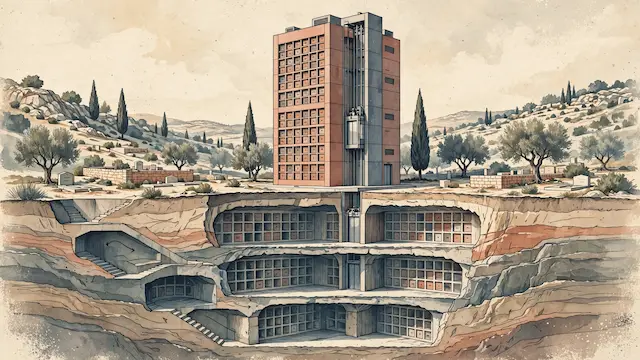
Israel is facing a severe shortage of cemetery space, forcing a shift towards multi-story, underground, and even elevator-accessed graves. At the Yarkon Cemetery in Petah Tikva, the only remaining free burial site in the Gush Dan region, traditional plots are nearly full. Consequently, the deceased are now being interred in multi-story buildings, with coffins transported via elevators to upper floors, a practice described by one mourner as "unusual but necessary due to lack of space."
This innovative approach to burial, while seemingly modern, draws inspiration from ancient Jewish traditions like cave and catacomb burials. Rabbi Yakov Rusa explains that leading ultra-Orthodox figures have deemed these new methods kosher, often after creative adaptations, such as connecting the burial chambers to the ground via pipes to maintain a link with the earth, fulfilling the Genesis commandment to return to dust.
Tuvia Sagiv, a cemetery architect, likens the situation to living in high-rise apartments while expecting to die in detached houses, arguing for the logic of vertical burial in a land-scarce country. The Yarkon Cemetery plans to construct 30 such buildings, accommodating an additional 250,000 graves, with a dozen already built, featuring terraced facades and open-air designs.
Experts like Alex Weinreb of the Taub Center for Social Policy Studies attribute Israel's burial crisis to a combination of religious-cultural norms, extreme land scarcity, and demographic trends. Rapid population growth and an aging populace are projected to significantly increase the annual death rate, with an estimated 2.2 million Israelis expected to die by 2050, far exceeding available traditional burial space.
Similar challenges are being addressed globally, with examples like a 32-story cemetery in Brazil and a six-story temple in Tokyo utilizing automated systems. In Israel, other cemeteries, like one near Jerusalem, are also expanding downwards, creating underground burial sections. Families are increasingly opting for these solutions, even if it means higher costs or traveling further, prioritizing their loved ones' wishes for burial arrangements.
Keep up with
Mentioned
Not the same event — other stories that share this one’s people, places, or theme: background, reactions, and follow-ups.
