
Wild Animals Increasingly Approach Humans in Israel, Posing Risks
Translated & summarized from Cursorinfo by baba
Wild animals are increasingly approaching humans in Israel, leading to dangerous encounters. Incidents include a boar injuring a runner in Haifa and a hyena killing a dog in Modi'in. Experts cite urban sprawl and accessible food sources as causes, while hunting is deemed ineffective for population control. Authorities are studying jackal behavior in Tel Aviv, implementing sterilization and tracking, and urging residents to secure trash and avoid feeding wildlife.
The story in 6 lines · by baba
- Wild animals in Israel are increasingly approaching humans, leading to dangerous encounters.
- A campaign against feeding wildlife, planned for June 2026, was postponed due to the war with Iran.
- Incidents include a boar injuring a runner in Haifa and a hyena killing a dog in Modi'in.
- Urban sprawl and accessible food sources are cited as primary reasons for animals entering settlements.
- Hunting is ineffective for controlling wild animal populations and can sometimes worsen the problem.
- Authorities in Tel Aviv are studying jackal behavior and implementing non-lethal control methods.
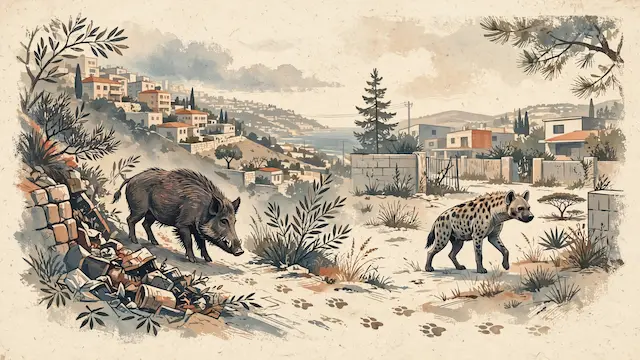
Wild animals in Israel are increasingly venturing into populated areas, presenting a growing danger to humans. An awareness campaign by the Israel Nature and Parks Authority, originally planned for June 2026 with the slogan "Stop Feeding the Animals," has been postponed due to the war with Iran. However, the animals have not waited for the conflict to end. Recent incidents include a wild boar severely injuring a runner in Haifa, mountain goats becoming a common sight in Midreshet Ben-Gurion and Mitzpe Ramon, and jackals roaming the streets of Gush Dan. In Modi'in, a hyena entered the Peled family's yard and killed their dog, Charlie, a loss the family is reportedly struggling with. Experts attribute this trend to urban sprawl reducing natural habitats and readily available food sources from unsecured garbage, open bins, and direct feeding, which draw animals into settlements. Professor Malinkson stated that hunting is ineffective for controlling wild animal populations like jackals and boars, as the removal of one animal often leads to its territory being occupied by others, preventing population decline. He noted that hunting can even accelerate reproduction in some species, like wild boars, exacerbating the problem. In Tel Aviv, home to hundreds of jackals, authorities are urging residents to secure trash bins and refrain from feeding wildlife. The municipality, in collaboration with Haifa University, is studying jackal behavior to find non-lethal conflict reduction methods. Some jackals have been sterilized, and 16 have been fitted with GPS trackers, though relocation attempts have failed, with the animals returning within days. One ecologist theorizes that urban jackals may be undergoing a process of self-domestication, becoming accustomed to humans and less fearful, though this remains unconfirmed. Despite reduced fear, jackals are still wild and can attack, particularly when protecting young. The boar attack in Haifa is considered unusual, with its cause still under investigation. While wild animals can experience stress, jackals bite far less frequently than domestic dogs, with hundreds of dog bites recorded annually in Tel Aviv alone, according to Professor Malinkson.