
Israeli Forces Raid West Bank; Settler Violence Escalates
Translated & summarized from Arab48 by baba
Israeli forces conducted widespread raids and arrests across the West Bank early Saturday, while settler attacks on Palestinians, their homes, and property escalated. The UN reported a record 435 settler attacks during the olive harvest season, impacting livelihoods and food security. These incidents follow Friday's raids and arrests, and ongoing settler attempts to seize land and establish new outposts. The UN warns of continued threats to Palestinian livelihoods and future agricultural productivity due to these escalating attacks and restrictions.
The story in 6 lines · by baba
- Israeli forces conducted widespread raids and arrests across the occupied West Bank early Saturday.
- Settler attacks on Palestinians, their homes, and property have escalated significantly.
- The UN documented a record 435 settler attacks during the recent olive harvest season.
- Settler violence has impacted Palestinian livelihoods and food security, with thousands of trees damaged.
- Israeli forces fired tear gas and sound grenades during raids and confrontations.
- The UN warns of expanding settler attacks and their threat to future agricultural productivity.
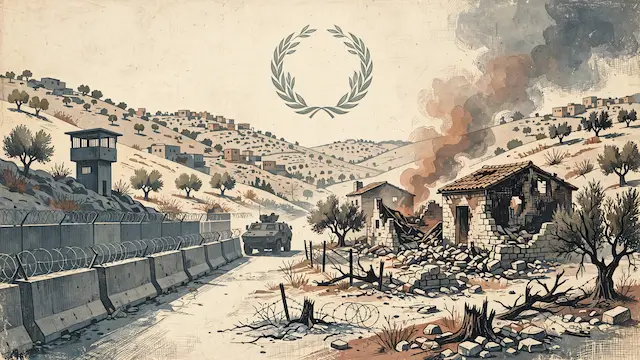
Israeli forces conducted widespread raids and incursions across the occupied West Bank early Saturday, encountering confrontations and attacking residents. Simultaneously, settlers continued their assaults on Palestinians, their homes, and property. These actions come amid UN warnings about the impact of settler violence on Palestinian livelihoods and food security, with a record number of attacks linked to the olive harvest season being reported.
Local sources reported that Israeli forces raided the city of Nablus, the village of Lubban al-Sharqiya, and the town of Sebastia, searching homes. Clashes broke out in Sebastia, where Israeli forces fired sound grenades. In the Ramallah governorate, forces raided homes in the village of al-Mazra'a al-Sharqiya and entered the Amari refugee camp. Similar raids occurred in Qalqilya and the town of Azzun. In the Hebron governorate, forces entered Yatta and the town of Beit Ummar. A young man was injured by Israeli soldiers during his arrest in Surif. Israeli forces also raided the Qalandia refugee camp and Jericho, and fired illumination flares over the northern areas of Tulkarm.
Settlers attacked homes with stones in a Bedouin community near the town of Jaba, north of occupied Jerusalem. Israeli forces fired tear gas at Palestinian vehicles at the Jaba checkpoint. On Friday, Israeli forces had already conducted raids and arrests in several West Bank governorates, detaining Palestinians, including a child and two released prisoners who were rearrested shortly after their release.
In parallel, settlers began plowing Palestinian land in Khirbet Yarza in the northern Jordan Valley on Friday, in an apparent attempt to seize it. Previous settler attacks had forced approximately 14 Palestinian families to abandon the community six months prior. Settlers also set up a tent near the town of Za'tara, east of Bethlehem, raising fears of a new settlement outpost. In Salfit, settlers threw stones at Palestinian vehicles, damaging at least two, and placed stones on the road to obstruct traffic. In Ramallah, settlers dumped garbage near a Palestinian home in the Turmus Ayya plain, while others, under Israeli military protection, entered the outskirts of the village of Yabrud and roamed near Palestinian homes.
The UN Office for the Coordination of Humanitarian Affairs (OCHA) reported on Thursday that it had documented 435 settler attacks related to the olive harvest season between September 1 and November 15, resulting in injuries or property damage. This marks the highest number of attacks recorded by OCHA in a single season since documentation began. The office also documented 55 settler attacks in 46 Palestinian communities between November 17 and 23, compared to a weekly average of 53 attacks since the start of the year. The report highlighted that settlers targeted vital infrastructure and livelihoods, including water and electricity networks, agricultural lands, and residential properties. The UN humanitarian team in the occupied Palestinian territories warned that settler attacks are expanding to areas previously experiencing fewer such incidents. Over 4,000 trees and saplings were damaged, and more than 25 tons of agricultural crops were destroyed or stolen during the current olive season. The UN estimates that 80,000 to 100,000 Palestinian families in the West Bank rely on the olive sector, which accounts for about 15% of the agricultural GDP. The UN cautioned that continued attacks and Israeli restrictions on farmers' access to their land threaten future olive tree productivity and directly impact the livelihoods of tens of thousands of Palestinian families.
Keep up with
Mentioned
The same event, reported separately by each outlet. Open a few to compare what different newsrooms emphasize — and what they leave out.
Arab 2

Not the same event — other stories that share this one’s people, places, or theme: background, reactions, and follow-ups.