
Jordan Bets on National Water Carrier to End Reliance on Israel
Translated & summarized from i24NEWS Arabic by baba
King Abdullah II of Jordan declared water security a priority, signaling a strategic shift away from reliance on external water sources, particularly Israel. Jordan faces severe water scarcity, exacerbated by internal mismanagement and a population increase, leading to a critical situation where only 80 cubic meters per person is available annually. The country is undertaking the multi-billion dollar Aqaba National Carrier project to build a desalination plant and pipeline, expected to be operational by 2029, but faces significant energy and financial hurdles. The project's success is vital for Jordan's future and regional stability, with questions lingering about potential Israeli involvement if the project fails.
The story in 6 lines · by baba
- Jordan's King Abdullah II declared water security a cornerstone of national sovereignty, aiming to reduce reliance on external sources.
- Jordan faces extreme water scarcity, with less than 80 cubic meters per person available annually, and 41% of water lost to leaks.
- Israel's decision not to renew an additional water supply agreement has heightened Jordan's concerns about its water security.
- The ambitious Aqaba National Carrier project aims to desalinate 300 million cubic meters of water annually, costing over $4 billion.
- The project, including a 450 km pipeline and a dedicated solar plant, is not expected to deliver water to Amman before 2029.
- Significant challenges include the high cost, energy demands, and potential for public unrest if water prices increase due to the project.
King Abdullah II of Jordan emphasized the critical importance of water, stating that water security is a cornerstone of national sovereignty and that Jordanians' right to water will not be held hostage. Speaking before parliament in Amman on November 2, 2026, the King, dressed in military attire, delivered a strategic message that many regional analysts interpreted as a response to political tensions over water supplies. Jordan's significant dependence on external sources for its water needs has been a growing concern.
Under a 1994 peace treaty, Israel is obligated to supply Jordan with 50 million cubic meters of water annually. A previous agreement for an additional 50 million cubic meters expired in late 2025 and was not renewed, reverting supplies to the treaty's base amount. This decision by Israel followed sharp diplomatic criticism from Amman on the international stage.
Jordan faces severe water scarcity, ranking among the three driest countries globally. With the international poverty line at 500 cubic meters per person annually, Jordan's average has fallen below 80 cubic meters. In Amman, water flows only once a week for a few hours, forcing residents to rely on large rooftop storage tanks. The population has also doubled to over 11 million, largely due to Syrian refugees, straining infrastructure.
Internal mismanagement exacerbates the crisis, with approximately 41% of drinking water lost due to aging pipes, leaks, and illegal connections. The agricultural sector consumes about half of the country's water for thirsty crops like bananas in arid regions, despite contributing less than 5% to the national GDP.
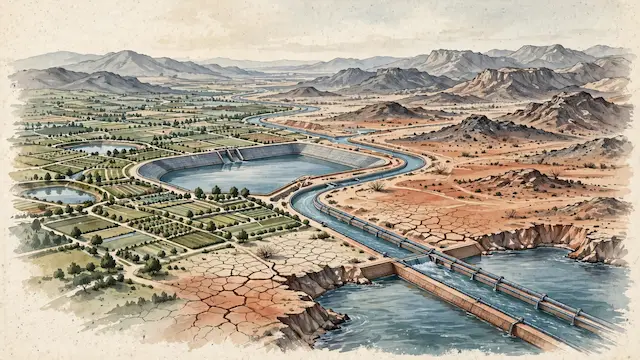
To address this dependency, Jordan is investing in the ambitious Aqaba National Carrier project. This plan involves building a massive desalination plant on the Red Sea coast to produce 300 million cubic meters of water annually. The water will be transported 450 kilometers north to Amman via a pipeline, requiring significant pumping stations. To power these, a dedicated 281-megawatt solar power plant is planned, though it will only cover about 30% of the pumps' energy needs, with the remaining 70% drawn from the national grid, which relies heavily on natural gas. The project's estimated cost exceeds $4 billion, with water not expected to reach Amman before 2029.
While technically feasible, the project faces challenges. Pumping costly desalinated water through a leaky network that loses over 40% is likened to filling a leaky bucket with liquid gold. Jordan's substantial debt raises concerns about potential water price hikes, which could spark public unrest. The success of this project is crucial for Jordan's future and regional stability, but questions remain about what would happen if the project falters and whether Israel might ultimately be compelled to intervene to ensure regional stability.
Keep up with
Mentioned