
Legal Expert Questions Prosecution's Case in Corruption Trial
Translated & summarized from Maariv by baba
Legal expert Professor Aviad Hacohen criticized the prosecution's handling of Case 4,000, suggesting they pursued charges as if favorable media coverage could prove bribery. He described the trial as excessively long and questioned the prosecution's strategy, noting that a prosecutor's office should not aim to guarantee convictions. Hacohen also highlighted the broader problem of protracted legal proceedings in Israel, which he termed a form of "cruel and unusual punishment."
The story in 5 lines · by baba
- Professor Aviad Hacohen criticized the prosecution's approach in Case 4,000, suggesting they treated media coverage as evidence of bribery.
- Hacohen described the ongoing trial as excessively long and questioned the prosecution's strategy.
- He stated that a prosecutor's office should not aim to guarantee a conviction.
- The legal expert called prolonged trials a form of "cruel and unusual punishment."
- Judges recommended reconsidering proceedings in Cases 4,000 and 2,000.
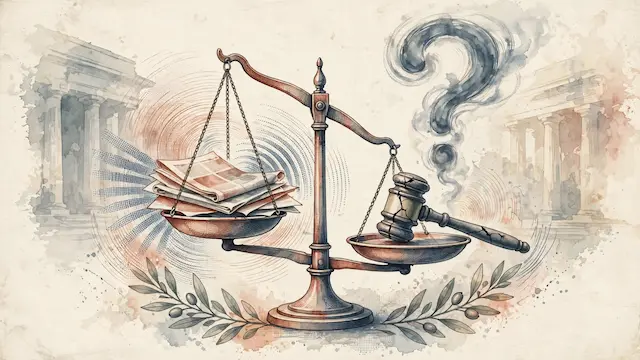
Following a recommendation from judges to reconsider proceedings in Cases 4,000 and 2,000, Professor Aviad Hacohen explained on 103fm that the prosecution may have overstepped. Hacohen described the ongoing trial as "stretched out and smeared like gum whose taste has long expired," suggesting the court is trying to focus only on aspects with a chance of conviction. He noted that the prosecution's case has evolved as more witnesses have testified, providing a clearer picture than at the trial's outset. Hacohen criticized the prosecution's approach in Case 4,000, stating that a prosecutor's office should not guarantee a conviction. He previously argued that Case 4,000, which he does not view as a bribery case, involved analyzing facts as if favorable media coverage could lead to a bribery conviction. "A whole team of people reached these conclusions, and we all see today that they were likely wrong," he said, referencing an article he wrote titled 'Convicting Many - Not Convicting.' Hacohen also addressed the broader issue of lengthy trials, calling prolonged legal proceedings a form of "cruel and unusual punishment" for the public and defendants, a phenomenon he believes the Israeli justice system has suffered from for decades. While acknowledging that mistakes leading to wrongful convictions occur globally, he urged proportionality in criticism, stating that most prosecution staff do not act with malicious intent or incompetence.
Keep up with
Mentioned

