
Messerschmitt Bf 109: The Deadly WWII German Fighter Jet
Translated & summarized from Calcalist by baba
The Messerschmitt Bf 109 was the deadliest fighter jet of World War II, credited with tens of thousands of aerial victories. Its innovative design and pilot skill made it dominant early in the war, but limitations in range and handling, along with the emergence of superior Allied aircraft, eventually diminished its effectiveness. A Czech-built variant, the AVIA S-199, served as Israel's first fighter jet during its War of Independence, earning the nickname 'Sakin' (Knife) due to its dangerous instability.
The story in 6 lines · by baba
- The Messerschmitt Bf 109 fighter jet achieved 15,000 to 20,000 aerial victories in WWII.
- Its design by Willy Messerschmitt featured advanced armament and agility.
- The Bf 109 proved highly effective in the Spanish Civil War and early WWII.
- The aircraft faced significant challenges against the British Spitfire and later Allied fighters.
- A Czech variant, the AVIA S-199, was Israel's first fighter jet, known as the 'Sakin' (Knife).
- Around 34,000 Messerschmitt Bf 109s were built in total.
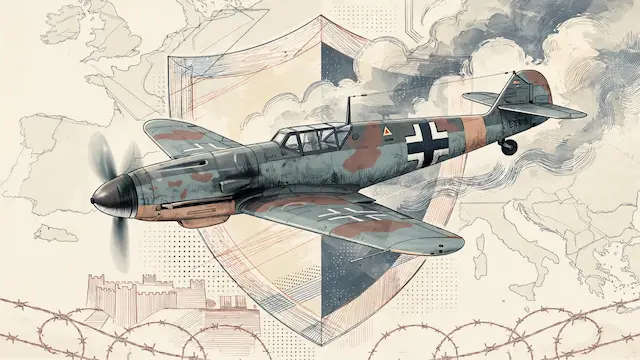
The Messerschmitt Bf 109, a German fighter aircraft, is considered the most lethal in history, credited with 15,000 to 20,000 aerial victories during World War II. Its success was partly due to its innovative design by Willy Messerschmitt, who overcame animosity from Erhard Milch, a powerful German Air Ministry official, to win a crucial tender for a new fighter. The Bf 109's design featured a narrow fuselage, a powerful Daimler-Benz engine, and a unique armament configuration with machine guns and a cannon firing through the propeller hub, offering superior accuracy and range compared to Allied aircraft.
Its agility in the air, with rapid climbing and diving capabilities, made it a formidable opponent. The aircraft first saw combat in the Spanish Civil War in 1936, where it proved highly effective against existing fighter designs. It continued to dominate in early WWII campaigns, including the invasion of Poland. However, its challenging handling characteristics and cramped cockpit made it difficult to fly and dangerous in emergencies, with pilots likening it to riding an uncooperative racehorse.
The Battle of Britain in 1940 presented a significant challenge when the Bf 109 encountered the British Spitfire. While the Bf 109 was faster in some aspects, the Spitfire was more agile, though it suffered from fuel flow issues during inverted flight. The Germans developed tactics to exploit the Spitfire's weaknesses, but the Bf 109's limited range over Britain proved a critical disadvantage.
Later in the war, the Bf 109 achieved its highest number of victories on the Eastern Front against Soviet aircraft, which were often technologically inferior and lacked effective communication. The German tactic of attacking in fours, which could split into pairs, proved superior to the Soviet's three-plane formations. The aircraft also played a key role in intercepting Allied heavy bombers like the B-17 and B-24, though the increasing range of Allied escort fighters like the P-51 Mustang eventually turned the tables.
By the war's end, the Bf 109's effectiveness was hampered by a lack of replacement parts, fuel shortages, and the attrition of experienced German pilots who flew until death, unlike Allied pilots who rotated out after a set number of missions. Post-war, around 34,000 Bf 109s of various models were built, with some serving in other air forces, including a Czech-built version, the AVIA S-199, which was acquired by Israel during its War of Independence and nicknamed the 'Sakin' (Knife) due to its instability and high crash rate.