
Palestinians in Europe Navigate Complex Identities and Public Life
Translated & summarized from Alarab by baba
Palestinians in Europe, including citizens of Palestinian descent, are navigating complex identities as they participate in public life and politics. While many have reached influential positions in countries like Sweden, Finland, Romania, and the UK, their engagement often faces scrutiny regarding their stance on Palestine. Palestinian community organizations also work to preserve heritage and foster dialogue, though they face internal and external challenges. The article suggests a mature approach to public engagement, balancing rights and responsibilities, is crucial for Palestinians to integrate without compromising their identity.
The story in 6 lines · by baba
- Palestinians in Europe are actively participating in public life, holding influential positions across various sectors.
- Engagement on Palestinian issues can lead to controversy and accusations for individuals of Palestinian origin in Europe.
- Palestinians in Europe represent diverse political affiliations, not a single unified bloc.
- Community organizations play a role in preserving Palestinian heritage and fostering dialogue.
- Challenges include internal disagreements, resource disparities, and the lack of a unified voice for the community.
- Mature public engagement requires understanding rights and boundaries to integrate without compromising identity.
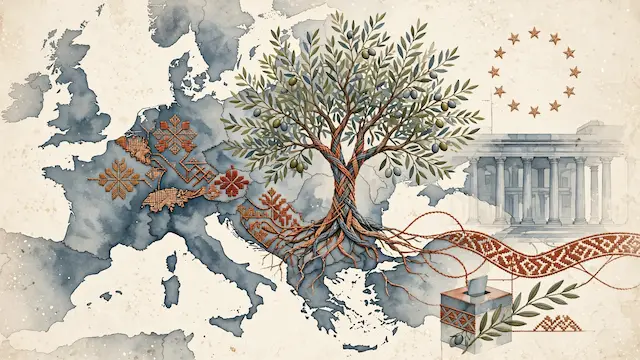
Palestinians living in Europe, including refugees, immigrants, and citizens of Palestinian descent, face a unique paradox: their cause remains prominent internationally, yet they reside in societies offering varying degrees of participation in decision-making, access to elected institutions, and prominent roles in academia, unions, and media. However, engaging in public life, especially concerning Palestine, can quickly lead to controversy and accusations.
The article explores the extent to which Palestinians in Europe influence their adopted societies, noting that citizenship defines legal belonging but doesn't erase familial roots or national identity. The core question is whether a Palestinian politician can act as a European citizen without constant scrutiny of their political identity in relation to their national origin.
Numerous examples illustrate Palestinians achieving influential political and professional positions across Europe. In Sweden, Evonne Roidah and Jamal Al Haj entered parliament for the Green Party and Social Democrats respectively, while Simona Mohamsson led the Liberal Party and served as Minister of Education and Integration. In Finland, writer and journalist Omia Abu Hanna served on the Helsinki city council. In Romania, Dr. Raed Arafat, founder of the "Samur" ambulance service, became a prominent figure in health and politics. In Britain, surgeon Ghassan Abu Sitta was elected honorary president of Glasgow University.
These individuals highlight that Palestinians in Europe are not a monolithic political bloc, with some aligning with left-wing parties and others with liberal or conservative ones, entering positions through diverse professional and political avenues. The article emphasizes that a person's relationship with the Palestinian cause shouldn't be solely judged by their party affiliation, nor should all individuals of Palestinian origin be expected to hold identical political views.
Beyond official positions, Palestinian associations and unions in Europe are active in culture, education, and historical preservation, organizing events and participating in discussions on immigration, discrimination, and human rights. These initiatives foster intergenerational connection to Palestinian heritage and facilitate dialogue about Palestine in diverse cultural contexts, particularly when led by second and third-generation Palestinians who understand both their heritage and European institutional workings.
However, community work faces challenges, including disparities in resources, internal political disagreements, and poor coordination among initiatives. Representing the community to European institutions is also difficult due to the lack of a single unified voice and the generational and political differences among Palestinians. The article concludes that while opportunities exist, they are not guaranteed. Palestinians must engage maturely, understanding their rights and boundaries, to build a presence that can withstand criticism and accusations with reasoned arguments, rather than withdrawing or viewing every critique as a conspiracy. A parliamentary seat is not an end in itself, but rather becoming an integrated part of public life, able to express opinions and engage in debate without their origin becoming a liability or an imposed political obligation.