
Debate Over Arab Parties in Government Reflects Modern Jewish Identity Crisis
Translated & summarized from Makor Rishon by baba
An article discusses the debate over including Arab parties in the Israeli government, arguing the core issue is their political stances, not ethnicity. It links this to a broader crisis in modern Jewish identity, where assimilation into liberal values dilutes unique Jewish characteristics and challenges the concept of a Jewish state. The author contrasts this with the Haredi community, whose identity is primarily cultural and religious, making them less concerned about the inclusion of Arab parties. The piece questions the future legitimacy of advocating for a distinct Jewish national identity within Israel.
The story in 6 lines · by baba
- The debate over Arab parties in government centers on their political views, not ethnicity, according to the author.
- Opponents of Arab party inclusion cite their views on Israel's legitimacy and Hamas as problematic.
- The article links the debate to a broader crisis in modern Jewish identity and its "translation" into liberal values.
- Assimilation into universal liberal concepts may be diluting unique Jewish identity and the concept of a Jewish state.
- Haredi leadership is less concerned about Arab parties due to their primarily cultural and religious identity.
- The author questions the future legitimacy of advocating for a distinct Jewish national identity in Israel.
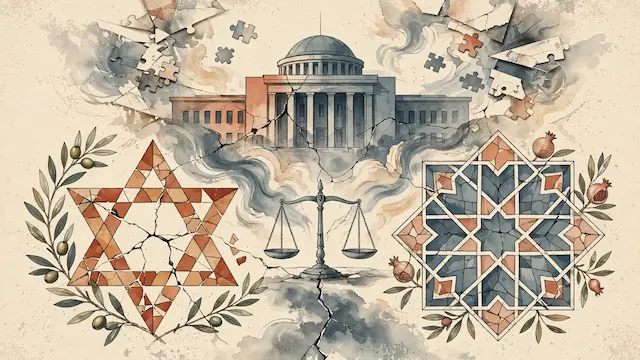
A central debate in Israel revolves around the inclusion of Arab parties in the government, with opponents often labeling such proposals as racist. However, the author argues that the core issue is not ethnicity but the political stances of these parties. Key figures within Arab parties are described as holding views that the state of Israel was born in sin, Arabs are the true owners of the land, and Zionism is nearing its end. Furthermore, these parties are said to struggle with condemning Hamas as a terrorist organization, often offering weak condemnations that equate IDF soldiers with perpetrators of genocide. The author contends that those who advocate for cooperation with such parties either deny these positions or dismiss them as free speech, with the ultimate goal being the removal of Benjamin Netanyahu from power.
The article posits that the discussion about Arab parties in government is part of a broader existential and identity-based discourse, extending beyond local politics. It draws parallels to the challenges faced by Jewish communities in the diaspora regarding "intermarriage" and the "translation" of Jewish identity into modern, liberal values. This "translation" process, while enabling integration, can dilute distinct Jewish identity by equating it with universal liberal concepts like equality and human rights, raising questions about what remains uniquely Jewish. The author suggests that this phenomenon also influences the perception of Israel among diaspora youth, leading to indifference or discomfort with the concept of "all of Israel" and a particular "Jewish state."
This identity struggle is also reflected in the Israeli discourse on the state's character. Some progressive voices frame the Israeli-Palestinian conflict through a lens of oppressors and oppressed, while some within the Zionist education system may legitimize Palestinian nationalism over Jewish nationalism. The author argues that while political debates are complex and involve various factors like suspicion and fear, a significant portion of the current discourse stems from this "identity discourse." Those whose identity is rooted in liberal discourse may feel uneasy with the Zionist project, while others, whose identity is tied to a dual sense of ethnic and cultural belonging, may resist the idea of replacing the Zionist vision with a "state for all its citizens."
Interestingly, the author notes that the Haredi (ultra-Orthodox) leadership is not troubled by the prospect of Arab parties participating in government. This is because, in many ways, their world is defined by a "halakhic" (religious law) and communal cultural identity, where the ethnic component is less problematic. This, surprisingly, places them on a similar identity footing to progressive liberals who have fully "translated" Judaism into secular values, for whom the ethnic aspect of Jewish identity becomes a challenge. The article concludes by questioning when dissenters from these prevailing views, such as those who oppose cooperating with current Arab parties or advocate for a Jewish national character in the state, will be marginalized, and when the concept of a "Jewish and democratic state" will become illegitimate.
Keep up with
Mentioned

