
Turkey Accuses Israel of Destabilizing Neighbors, Sparking Heated Debate
Translated & summarized from i24NEWS Arabic by baba
Turkish Foreign Minister Hakan Fidan accused Israel of destabilizing regional countries and warned of a wider confrontation if military actions in Syria continue. During a televised debate, Turkish researcher Mohannad Hafezoglu echoed these concerns, criticizing Israel's actions and aligning Turkey with regional stability efforts. Israeli political science professor Meir Israeli countered, calling the accusations unrealistic and blaming Turkey's current government for strained relations, while defending Israel's regional policies.
The story in 6 lines · by baba
- Turkish Foreign Minister Hakan Fidan accused Israel of seeking to destabilize regional countries.
- Fidan warned that Israeli military actions in Syria could lead to a wider regional confrontation.
- Turkish researcher Mohannad Hafezoglu accused Israel of acting like an armed gang, not a peace-seeking state.
- Israeli professor Meir Israeli called the accusations unrealistic and blamed Turkey's government for strained relations.
- Israeli denied that Israel has armed factions to destabilize neighboring countries.
- The debate highlighted opposing views on Israeli and Turkish influence and regional stability.
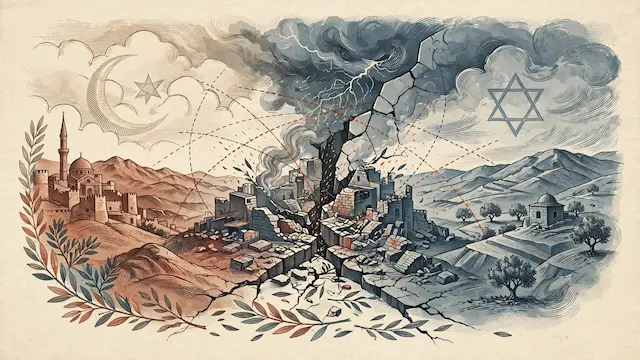
Turkish Foreign Minister Hakan Fidan accused Israel of seeking to destabilize the region and keep neighboring countries weak and divided. He warned that any new military action in Syria could lead to a wider regional confrontation, suggesting that Israeli-backed groups are attempting to provoke the Syrian army to create a pretext for military intervention. Ankara has conveyed these warnings to its allies, including the United States and European nations.
During a televised debate on i24NEWS Arabic, the discussion on Ankara's accusations against Israel devolved into a sharp confrontation between two guests offering starkly opposing views on the motivations behind Turkish and Israeli policies and the future of Syria and the region.
From Istanbul, academic and political researcher Mohannad Hafezoglu argued that Israel's problem lies in its lack of pursuit of peace or stability. He contended that both Israeli and Iranian agendas aim to dismantle regional states and plunge them into chaos, whether through Iranian militias or Israeli actions in southern Syria, its occupation of southern Lebanon, and escalation in Gaza and the West Bank. Hafezoglu asserted that Israel acts like an armed gang rather than a state seeking peace, noting that regional nations, both Arab and Turkish, desire stability. He added that Ankara is aware of attempts to instigate unrest in southern Syria via "Al-Hijri" and his group and is working to defuse them and thwart disintegration plans, stating that the majority of the Druze population supports the Syrian state and that the border with Israel is in Daraa, not Sweida. Hafezoglu also rejected the notion of the Palestinian people being merely a "component," emphasizing their historical and geographical claim to the land and Turkey's clear support for Hamas, which it does not classify as a terrorist organization, while Israel arms groups within Syria.
The Turkish political researcher further suggested that Israel exploits countries like Greece and Cyprus by instilling fear of Turkish influence to push them towards arms deals. He believes that Greece and Turkey share common interests and that Turkish-Arab rapprochement represents "one nation" with a unified security logic that disrupts the calculations of disintegration projects in the region and presents Israel with a new reality.
Conversely, Professor of Political Science at the Hebrew University, Meir Israeli, from Jerusalem, dismissed these claims as unrealistic. He asserted that Israel is a stable country in the region and that Israeli-Turkish relations were excellent for many years, including military cooperation, even before the withdrawal from Gaza or the Oslo Accords, dating back to when Turkey was the first Muslim country to recognize Israel in 1949. Israeli attributed the deterioration of relations to the rise of what he described as an "extremist" and "Islamist" party to power in Turkey, suggesting that Ankara fabricates crises with Israel for internal and regional propaganda and political purposes, interferes in the internal affairs of other countries, harbors Hamas leaders, and supports extremist currents in the region.
Israeli denied that Israel has armed or trained Kurdish, Druze, Alawite, or Christian factions to destabilize neighboring countries, stating only that there are general relations or declared political support on issues like self-determination or the Kurdish referendum. He stressed that Syria is an independent state and Turkey has no right to act as its guardian or interfere in its affairs, pointing out that Turkey itself occupies territory in Syria and northern Cyprus, violating international norms and maritime border demarcations. Israeli also defended Israel's positions on the Palestinian issue, past agreements, and the withdrawal from Gaza and Sinai. He presented a sharp historical and identity-based perspective, asserting that Israel's roots in the region predate newly formed states, criticizing the Istanbul guest's rhetoric as lacking adherence to the etiquette of dialogue or international law.
The debate intensified throughout the program regarding the limits of Turkish and Israeli influence in Syria, the role of local factions and components, and the future of regional understandings amidst converging interests and escalating political and historical rhetoric between the two sides.
Keep up with
Mentioned

