Tel Aviv Stock Exchange Faces Volatile Week Amid Global and Local Uncertainty
Translated & summarized from Ice by baba
The Tel Aviv Stock Exchange saw significant declines and a weakening shekel during the week of November 16-20, 2026, influenced by Wall Street's performance and Israeli political uncertainty. Major indices like the TA-35 fell over 4%, while the dollar rose 4% against the shekel. Investors favored money market and foreign equity funds, with bond markets showing mixed results despite substantial fundraising.
The story in 5 lines · by baba
- Tel Aviv Stock Exchange indices fell sharply, with TA-35 down 4.37% in the week ending Nov 20, 2026.
- The Israeli shekel weakened significantly, with the dollar rising 4.0% to 3.326.
- Domestic institutions sold 447 million shekels in bank stocks, while foreign investors bought 253 million shekels.
- Bond market fundraising reached 7.8 billion shekels, led by the financial sector.
- Investors favored money market and foreign equity funds, pulling money from local stock funds.
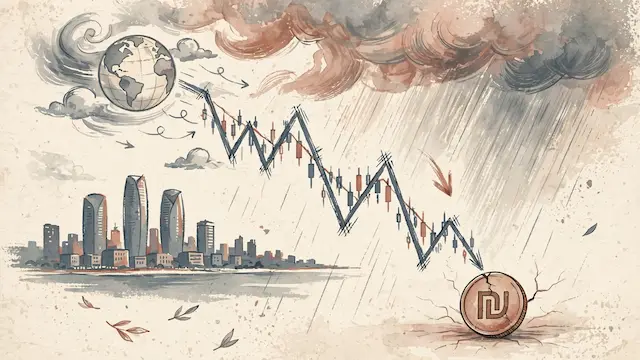
The Tel Aviv Stock Exchange experienced a turbulent trading week from November 16-20, 2026, marked by sharp declines across major indices and a significant depreciation of the Israeli shekel against foreign currencies. This downturn mirrored negative trends on Wall Street, particularly in technology and semiconductor stocks, and was exacerbated by increased political uncertainty within Israel.
The stock market saw broad-based losses, with the TA-35 index dropping approximately 4.37%, the TA-125 falling by about 4.29%, and the TA-90 decreasing by roughly 4.61%. Sector-wise, construction and banking indices led the decline. Notably, while domestic institutional investors sold about 447 million shekels net in bank stocks, foreign investors took advantage of the lower prices, purchasing bank stocks worth approximately 253 million shekels net.
In the currency markets, the Israeli shekel weakened considerably. The US dollar surged by about 4.0% against the shekel, closing at 3.326 on November 20. The Euro strengthened by approximately 3.1%, and the British Pound rose by about 2.9%.
The bond market presented a mixed picture. Short and medium-term Israeli government shekel bonds showed resilience, with slight gains, while longer-term and inflation-linked bonds recorded decreases. The yield on Israeli government bonds rose, contrasting with a decrease in US Treasury yields. Despite market volatility, the bond market saw substantial activity, with gross fundraising reaching approximately 7.8 billion shekels. The financial sector led these efforts, with Bank Hapoalim raising about 3.86 billion shekels, followed by Partner and Paz.
In the mutual fund sector, investors channeled funds into money market funds and global equity funds, indicating a preference for safer assets and international diversification. Money market funds attracted about 550 million shekels, and passive funds tracking foreign stock indices drew about 767 million shekels. Conversely, traditional mutual funds and passive funds tracking the Tel Aviv stock market experienced outflows.
Keep up with
Mentioned