
Oxfam Report: Israeli Attacks Turned Gaza Into Toxic Waste Zone
Translated & summarized from Arab48 by baba
An Oxfam report states that Israeli military actions have transformed Gaza into a toxic waste zone, rendering it uninhabitable and threatening human life. The extensive destruction and use of munitions have severely contaminated water, soil, and air with hazardous pollutants. The report details widespread damage to infrastructure, including water systems, and calls for an end to attacks, unimpeded access for experts, and compensation for environmental damage.
The story in 6 lines · by baba
- Oxfam report details how Israeli attacks turned Gaza into a toxic waste zone threatening human life.
- Destruction of buildings and use of munitions have contaminated Gaza's water, soil, and air with hazardous pollutants.
- 78 percent of Gaza's territory was subjected to Israeli ground attacks, leading to widespread environmental damage.
- 85 percent of Gaza's water infrastructure destroyed, with 16 percent of residents lacking clean water in June 2024.
- Oxfam calls for an end to attacks, unimpeded expert access, and compensation for environmental damage.
- The report claims this situation violates international humanitarian law and Israeli obligations.
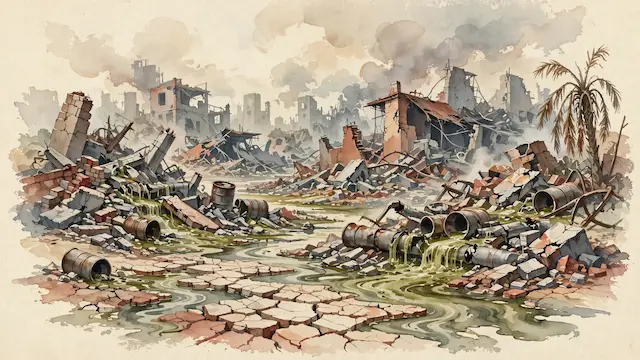
Israeli military actions have rendered Gaza uninhabitable and created a toxic waste zone that threatens human life, according to a report by the international relief organization Oxfam. The report, titled "Environmental War Crimes: How Israeli Military Attacks Turned Gaza Into a Toxic Waste Zone Threatening Human Life," details the severe environmental consequences of the ongoing conflict.
Oxfam, headquartered in Britain, stated that the destruction of buildings, use of munitions, and rocket fuel have contaminated Gaza's water, making it undrinkable, and polluted the soil, impacting public health. The report highlights that the scale and intensity of the destruction have fundamentally altered Gaza's environment, leading to the release of hazardous pollutants into the soil, water, and air. These contaminants are expected to have profound and long-lasting effects on environmental resources and the health of the population.
The report utilized satellite imagery, analyses, and attack maps to identify pollution hotspots. It found that 78 percent of Gaza's territory has been subjected to Israeli ground attacks. The extensive use of munitions, coupled with strikes on critical infrastructure such as wastewater treatment plants, industrial facilities, power stations, and waste management sites, has resulted in the leakage of complex waste materials, including explosive remnants, rocket fuel, heavy metals, and pathogens.
Oxfam indicated that at least one pollutant has leaked into the environment across 99 percent of Gaza. Residents are exposed through inhalation, consumption of contaminated food and water, and direct contact with polluted soil and water. The most polluted areas identified include central Gaza City, Khan Younis, Rafah, Jabalia, and Salah al-Din Street, while central Gaza City and Jabalia are noted as the most air-polluted zones due to smoke and gases from explosions and fires.
The report also revealed that 85 percent of Gaza's water infrastructure has been destroyed, with water tanks completely ruined. In June 2024, 16 percent of Gazans lacked access to clean water, a significant increase from 39 percent in April 2024. Tests showed that fecal coliform bacteria levels in the water exceeded 2021 levels by more than tenfold. Oxfam called for an immediate cessation of attacks, unimpeded access for humanitarian workers and environmental experts, disclosure of munition types and components used by the Israeli military, and compensation for environmental damage. The organization urged the international community to pressure Israel to facilitate environmental risk assessments and to halt arms sales to the country.
Keep up with
Mentioned
The same event, reported separately by each outlet. Open a few to compare what different newsrooms emphasize — and what they leave out.
Left 1Arab 1

Not the same event — other stories that share this one’s people, places, or theme: background, reactions, and follow-ups.
