
Israel's Central Bank Faces Dilemma as Inflation Falls, Shekel Weakens
Translated & summarized from Globes by baba
Israel's central bank is expected to hold interest rates at 3.25% due to a dilemma between falling inflation and a weakening shekel. The shekel has depreciated significantly, raising concerns about renewed inflationary pressures, despite inflation dropping to 1.1%. Political and security uncertainties, alongside potential interest rate hikes in the US, are contributing to the shekel's weakness. Analysts project inflation to rise again, complicating the central bank's decision-making process.
The story in 5 lines · by baba
- Israel's inflation has fallen to 1.1%, but the shekel's sharp depreciation poses a risk of renewed price increases.
- The Bank of Israel is expected to maintain its interest rate at 3.25% due to conflicting economic signals.
- Political and security uncertainties are major factors contributing to the shekel's weakness against the dollar.
- Analysts predict inflation to rise again in the coming year, limiting the central bank's options for rate cuts.
- The Israeli economy shows strong growth, but the labor market is exhibiting signs of moderation.
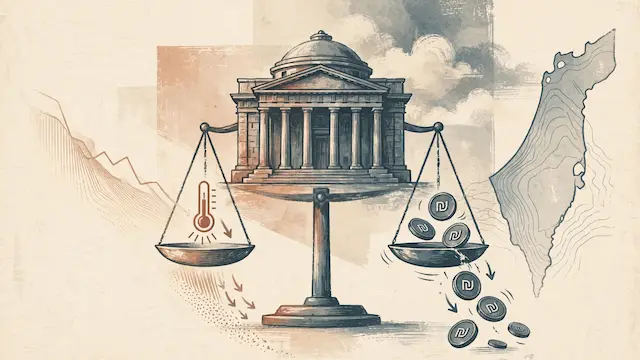
Israel's central bank is grappling with a complex economic situation as inflation drops to 1.1%, nearing the lower bound of its target, while the Israeli shekel has weakened significantly against the dollar, reaching levels not seen since September 2025. This divergence presents a dilemma for the Monetary Committee, as falling inflation might suggest an interest rate cut, but the weakening shekel risks reigniting inflationary pressures.
Market expectations are that the Bank of Israel will keep the interest rate unchanged at 3.25% at its upcoming meeting. This decision is influenced by three interconnected factors: political and security uncertainty, the shekel's depreciation, and the potential for widening interest rate differentials with the United States. Despite inflation being low, analysts like Yoni Pening from Mizrahi Tefahot project it to rise to 2.3% within the next year, suggesting the current low figures might not persist.
Economic activity in Israel remains robust, with the economy growing at an 8% annual rate in the third quarter, though this figure is adjusted to 4% when accounting for overseas production by Israeli companies. Private consumption and investment in fixed assets also saw significant increases. However, the labor market shows signs of cooling, with a decrease in job vacancies and a rise in labor force participation, potentially easing wage pressures.
The immediate concern, however, lies in the foreign exchange market. The shekel has depreciated by approximately 4.6% against the dollar in the past week, driven by global market downturns and heightened uncertainty in Israel, including fears of political instability and further elections. This depreciation could offset global price reductions, particularly in energy, and increase import costs, thereby impacting inflation expectations and limiting the central bank's room to maneuver on interest rates.
The Bank of Israel's challenge is to balance the need to support the economy with potentially lower interest rates against the risk of currency depreciation fueling inflation. A rate cut could further weaken the shekel, while maintaining high rates, as advocated by Nimrod Sapir of the Investment Houses Association, burdens households and businesses. The next interest rate decision is scheduled for January 4th, but its outcome will likely depend on the stabilization of the shekel and a clearer political and security outlook.
Keep up with
Mentioned


