
Market Corrections Now Happen in Days, Not Months, Expert Says
Translated & summarized from Globes by baba
Market corrections are now occurring in days rather than months due to electronic trading, according to Lior Yochafaz, Chief Investment Officer at Menora Mivtachim. He observed a shift from aggressive tech stocks to consumer staples, questioning current valuations. Yochafaz believes the AI revolution is a structural change, not a bubble, and advises caution but not panic, suggesting the Israeli stock market as a stable alternative.
The story in 5 lines · by baba
- Market corrections now happen in days, a drastic change from the months they previously took.
- Investors are shifting from chip stocks like Nvidia to consumer staples, creating unusual valuations.
- The uncertainty around AI monetization is a key driver of current market volatility.
- Unlike the dot-com bubble, today's tech giants are profitable and cash-rich.
- The Israeli stock market is presented as a stable alternative to volatile U.S. markets.
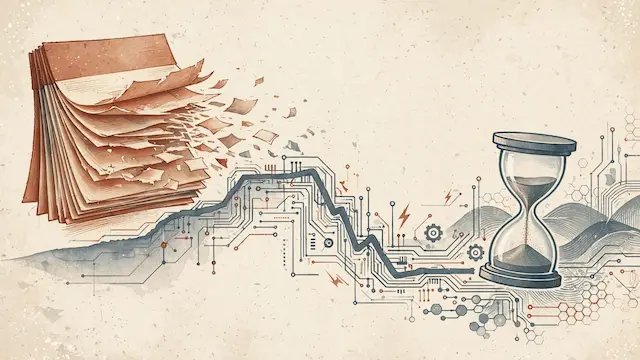
The recent sharp declines on Wall Street are part of a more aggressive market correction, according to Lior Yochafaz, Chief Investment Officer at Menora Mivtachim. He noted a surprising shift where investors are moving away from chip stocks, like Nvidia, and towards basic consumer goods companies, such as Costco. Yochafaz described this as "crazy," pointing out that consumer staples are trading at high price-to-earnings multiples (30-40) while Nvidia is at a multiple of 10, questioning the logic of such valuations.
He explained that in the past, market corrections took months or even a year, but today, due to electronic trading systems, these adjustments happen rapidly, sometimes within minutes. Yochafaz predicts these corrections, which used to occur every five to ten years, will now happen every one to two years, with significant drops occurring in just two days instead of two to three months.
The current market volatility is partly driven by uncertainty surrounding the monetization of Artificial Intelligence (AI). Yochafaz compared it to the early days of the internet in 2000, when the business models were unclear. However, he stressed that AI represents a fundamental structural change, and companies that do not embrace it risk obsolescence, citing examples like Blockbuster and Kodak.
Yochafaz believes this is not a bubble because AI is expected to be widely used in the future. He attributes some of the selling to investors taking profits after significant gains, especially when market "noise" emerges. He differentiated the current situation from the dot-com bubble of 2000, emphasizing that today's leading tech companies (Google, Microsoft, Amazon) are profitable and cash-rich, unlike the speculative internet firms of that era.
For investors seeking opportunities, Yochafaz advised looking at technology companies, particularly in chips and data centers, but with careful attention to valuation and business models. He highlighted that some growing companies with strong order backlogs are trading at historically low multiples. For those wary of U.S. market volatility, he suggested the Tel Aviv Stock Exchange as a stable alternative, driven by sectors like banking, insurance, and real estate, offering a solid investment in the Israeli economy.