
US Aims to "Strangle" Iran Economically, Avoiding Full-Scale War
Translated & summarized from Cursorinfo by baba
The U.S. is intensifying economic pressure on Iran through a blockade of maritime and land trade routes, aiming to avoid direct military conflict. This strategy, favored by President Donald Trump, seeks to cripple Iran's economy and force concessions on its nuclear program and security issues. The U.S. is coordinating with Persian Gulf states and Israel on regional defense, while also maintaining diplomatic channels with Tehran. Officials are wary of repeating past mistakes, such as the Iraq war justification, and prefer gradual economic attrition over immediate large-scale military action.
The story in 6 lines · by baba
- US President Donald Trump opts for economic blockade to 'strangle' Iran, avoiding full-scale war.
- Washington plans to block Iran's maritime and land trade routes, including those via Iraq.
- Persian Gulf states and Israel are cooperating with the US on regional defense against Iran.
- US officials fear repeating the 2003 Iraq invasion's flawed justifications for war.
- Diplomatic channels remain open, with envoys engaging Qatar and Pakistan as intermediaries.
- Iran is reportedly preparing to counter the US naval blockade with oil tankers.
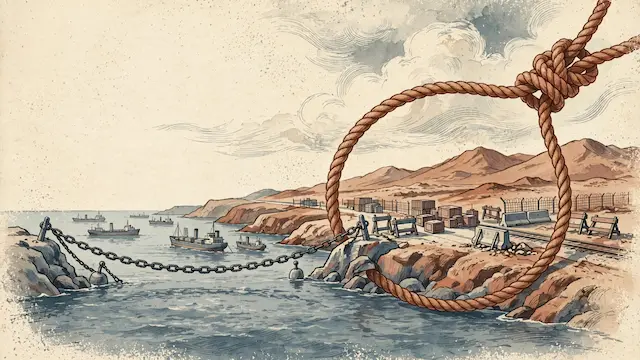
The United States, under President Donald Trump, is opting for an intensified economic blockade against Iran rather than a full-scale war at this stage. This strategy aims to cut off Iran's primary revenue streams by blocking not only maritime but also land trade routes, compelling Tehran to accept U.S. terms. According to diplomatic sources, the U.S. president has chosen a path of gradual economic attrition, though the military option remains on the table. The U.S. Central Command has been instructed to enhance operations protecting shipping in the Persian Gulf and continue the naval blockade of Iranian vessels.
The Trump administration considered four main scenarios: a new agreement, renewed large-scale hostilities, limited strikes on strategic military sites, and continued economic pressure. The first was rejected due to Iran's stance, and the second was deemed too risky for Persian Gulf states. Consequently, the economic strategy, supported by Secretary of State Marco Rubio, Treasury Secretary Scott Bessent, and Commerce Secretary Howard Lutnick, was favored. A key factor is the restoration of oil tanker traffic and the stabilization of oil prices, enabling the U.S. to increase pressure without immediate military action.
Washington plans to block Iran's land export routes, with a particular focus on Iraq, through which a significant portion of Iranian oil exports allegedly transit. Iranian oil is reportedly transported in large convoys to Iraq, where its origin is disguised as Iraqi or Kurdish, before being moved to Syrian and Turkish ports to bypass sanctions. The U.S. seeks to halt these operations with the support of Arab states in the Persian Gulf, whose leaders have pledged assistance, including pressure on Baghdad.
For Iran, land trade is a vital means of maintaining economic activity amidst the maritime blockade. Closing these routes would further limit export revenues and complicate foreign trade. Persian Gulf nations are keen to neutralize the Iranian military threat but fear the consequences of a new large-scale conflict. A senior UAE official warned that regional countries could only compensate for Iranian attacks for a limited time, emphasizing the need for any renewed hostilities to have specific, sustainable objectives.
Concurrently, efforts are underway to bolster air defenses for strategic sites, including oil and gas facilities and water desalination plants. Israel is also participating in regional defense preparations against potential Iranian attacks, with Israeli political and security representatives engaging directly with several Persian Gulf states, even those without diplomatic ties to Israel. This cooperation aims to prepare for potential hostilities and protect critical infrastructure, while also offering Israel opportunities to strengthen regional ties against the common threat from Tehran.
President Trump has also ordered increased surveillance of Iran's nuclear, missile, and suspected chemical and biological weapons facilities. Israel has shared intelligence on Iran's potential chemical program, though this information reportedly did not sway the U.S. administration from its chosen strategy. U.S. officials are wary of repeating the situation preceding the 2003 Iraq invasion, where claims of weapons of mass destruction were a primary justification but later proved unfounded. Former Israeli Prime Minister Benjamin Netanyahu's 2002 testimony to a U.S. congressional committee about Iraq's nuclear weapons development is cited in this context. Supporters of a cautious approach within the current U.S. administration favor continued economic pressure, reserving the option for targeted military operations.
Despite the hardline stance, diplomatic channels with Tehran remain open. Special Envoys Steve Witkoff and Jared Kushner continue to engage with Qatari intermediaries, and U.S. proposals are also conveyed through Pakistan. Trump has reportedly warned Iran that the blockade will persist until key U.S. demands regarding its nuclear program, Strait of Hormuz shipping, and other security issues are met. Treasury Secretary Scott Bessent anticipates that sustained economic pressure will exacerbate internal divisions within Iran's leadership, forcing a return to negotiations. However, he acknowledges that a heavily pressured Tehran might resort to indiscriminate attacks in the Middle East before agreeing to a deal.
Mentioned

