
Child Fatally Shot En Route to UNRWA School in Jerusalem
Translated & summarized from Alarab by baba
Ten-year-old Qusai Al-Joulani was fatally shot on November 21, 2026, while on his way to an UNRWA school in Jerusalem's Shuafat refugee camp. An unknown assailant on a motorcycle fired at the child, who later died from his injuries. Israeli police are investigating a potential criminal motive, and a suspect has been arrested. The incident has sparked broader discussions about child safety and the impact of violence on innocent lives.
The story in 5 lines · by baba
- Ten-year-old Qusai Al-Joulani was fatally shot on his way to an UNRWA school in Jerusalem on November 21, 2026.
- The child was shot by an unknown assailant on a motorcycle near the school entrance.
- Israeli police are investigating a potential criminal motive for the shooting.
- A suspect was arrested in a nearby village, and a burnt motorcycle was found.
- The incident raises concerns about child safety and the infiltration of violence into innocent spaces.
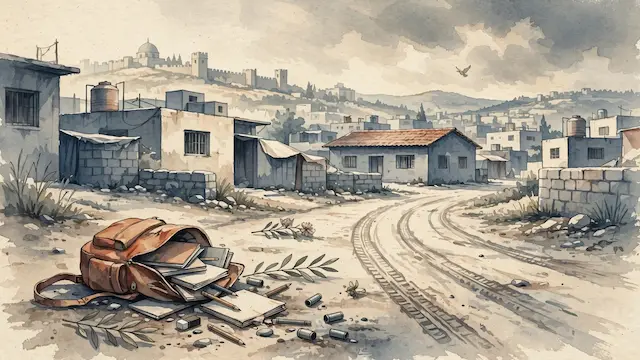
Ten-year-old Qusai Al-Joulani was killed by gunfire on his way to an UNRWA school in Shuafat refugee camp, northeast of Jerusalem, on Saturday, November 21, 2026. The boy was shot by an unknown assailant on a motorcycle, sustaining critical injuries. He was transported to the hospital, where he was pronounced dead. The incident occurred near the school entrance, a place meant to be a sanctuary for children.
Israeli media reports, citing witnesses, suggest the shooter approached Al-Joulani at close range while the child was carrying his schoolbag. The Israeli police's initial assessment pointed to a potential criminal motive, possibly a dispute between criminal elements or a case of mistaken identity. Later reports indicated the arrest of a suspect in the nearby village of Al-Jib, where a burnt motorcycle, suspected to be linked to the crime, was found. However, the article emphasizes that an arrest does not equate to guilt, and the final responsibility rests on the investigation's outcome and judicial proceedings.
The article reflects on the broader implications of the shooting, questioning how armed violence has infiltrated spaces associated with childhood innocence. It highlights the dangers of widespread weaponry and criminal disputes when innocent individuals become potential targets, impacting the community's right to life and security. The author stresses that justice requires uncovering the circumstances, assigning responsibility, and prosecuting the guilty, alongside addressing the conditions that allow such crimes to recur.
The piece calls for genuine protection for children in their neighborhoods and schools, a societal stance that rejects and does not normalize violence, and institutional responsibility prioritizing human life. It warns that a society accustomed to hearing about the deaths of its children loses a part of its humanity and its ability to protect its future with each incident. The author expresses a desire for Al-Joulani's story to serve as a testament against unacceptable violence and to uphold every child's right to reach school safely.




