
Israeli Soccer League Faces Extended Break Due to Field Maintenance
Translated & summarized from Mako by baba
Israeli soccer leagues are on an extended 19-day break for field reseeding, a process necessary due to the country's climate requiring two types of grass. This maintenance is longer than in Europe because Israeli stadiums host multiple teams, straining the turf. While other nations have similar practices, the high stadium occupancy in Israel makes alternative solutions difficult. The league is set to resume on November 27th.
The story in 5 lines · by baba
- Israeli soccer leagues are on a 19-day break for field reseeding, longer than European leagues.
- The extended break is due to Israel's climate requiring two types of grass: summer and winter.
- Stadiums in Israel host multiple teams, complicating field maintenance and recovery.
- Alternative solutions like temporary stadium relocation are impractical in Israel.
- The league is scheduled to resume play on November 27th.
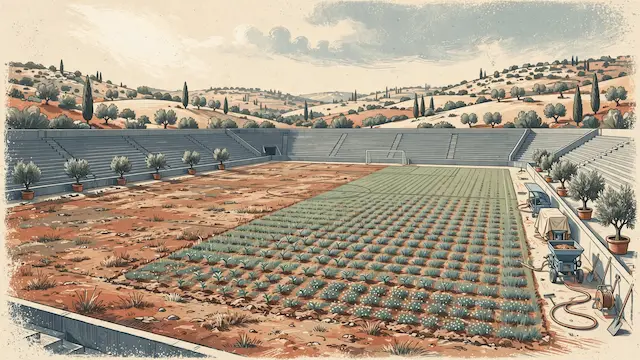
Israeli soccer leagues are experiencing a significantly longer break than their European counterparts due to a process called "reseeding" or "shizrua" in Hebrew. This essential maintenance involves planting new grass within existing turf to renew it, a practice common globally but uniquely prolonged in Israel.
The extended hiatus, lasting 19 days, means teams like Manchester United will play multiple games before an Israeli team plays even one. The necessity for this break stems from Israel's unique Mediterranean climate, which requires two different types of grass: a summer variety and a winter variety. Unlike in many European countries with more consistent weather, Israeli fields cannot sustain a single type of grass year-round.
Ilan Yablochkovsky, manager of Netanya Stadium, explained that maintaining the winter grass alone can cost hundreds of thousands of shekels annually. The reseeding process itself takes about three weeks, during which the grass needs to rest. This transition between grass types is crucial due to sharp weather changes and intense, short winter systems in Israel.
While other countries also have winter breaks for field maintenance, Israel's situation is exacerbated by the heavy usage of stadiums. Many stadiums host multiple teams, creating a domino effect that makes it difficult for fields to recover. For instance, Netanya Stadium has historically accommodated three or four home teams, in addition to other events.
Solutions seen elsewhere, like teams temporarily relocating to alternative stadiums for a few games, are impractical in Israel due to the high demand and limited number of venues. Cyprus, with a similar climate, sees teams move for one or two matches. More expensive solutions, such as complete turf replacement with artificial fibers like those used at Milan's San Siro stadium, are financially prohibitive for Israeli clubs.
Future stadium construction is expected to alleviate some of the pressure on existing fields, but for now, fans will have to wait for the league to resume on November 27th.
Mentioned
The same event, reported separately by each outlet. Open a few to compare what different newsrooms emphasize — and what they leave out.
Centre 2

Not the same event — other stories that share this one’s people, places, or theme: background, reactions, and follow-ups.