
Nvidia Suffers Worst Week Since 2008 Amid AI Bubble Fears
Translated & summarized from Calcalist by baba
Nvidia experienced its worst week since 2008, with its stock falling 23% amid a broader market sell-off and fears of an AI bubble. The chip giant's stock has lost nearly half its value since an October high. Concerns about AI investment returns, U.S. export restrictions to China, and leadership issues surrounding CEO Jensen Huang contributed to the decline. The situation could impact the Israeli economy due to its reliance on Nvidia.
The story in 5 lines · by baba
- Nvidia stock suffered its worst week since 2008, dropping 23% amid market turmoil.
- The chip giant has lost nearly 48% of its value since its October all-time high.
- Broader market indices also saw significant declines, with the Nasdaq down 5.3% on Friday.
- Concerns about an AI bubble, export restrictions, and leadership issues fueled the sell-off.
- The crisis could have repercussions for the Israeli economy due to its reliance on Nvidia.
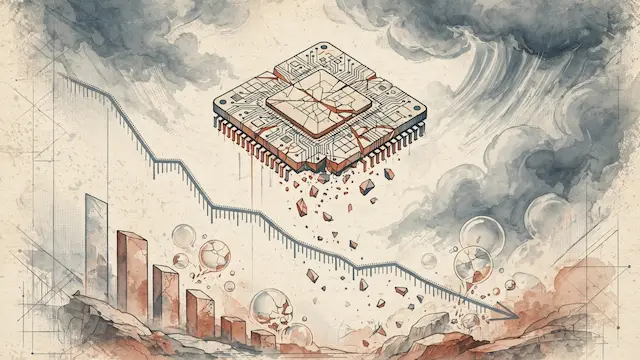
Nvidia, a symbol of the artificial intelligence boom, experienced its worst week on Wall Street since the height of the 2008 financial crisis. The chip giant's stock plummeted 14% on Friday, capping a weekly decline of 23%, its worst weekly performance since 2008, according to Dow Jones data. The stock has now fallen for seven consecutive weeks, losing nearly 48% of its value since reaching an all-time high on October 6.
The collapse in Nvidia's stock occurred amid a sharp sell-off on Wall Street that dragged down major U.S. indices on Friday. The Nasdaq Composite plunged 5.3%, erasing its year-to-date gains, while the S&P 500 lost 3.7% and the Dow Jones fell 1.9%. The VIX fear index surged 32% as investors worried about the massive investments in AI and companies' ability to generate returns.
Other notable decliners included Anthropic, which lost 8.5% on its second day of trading after a massive IPO, Intel fell 8%, and AMD and Micron dropped over 13% each. The sell-off in chip stocks was particularly severe. The PHLX Semiconductor Index (SOX) dropped 10.7% on Friday, completing a weekly decline of 17.1%, its worst weekly performance since September 2001. In total, $2.3 trillion was wiped from the market capitalization of chip companies within a week, with $1.3 trillion lost on Friday alone.
Underlying the declines are concerns about the bursting of the AI bubble, coupled with new restrictions on advanced chip exports to China and potential new U.S. Congressional legislation that could burden the industry. The sharp drops at Nvidia follow weeks of turmoil within the company. Allegations regarding CEO and Founder Jensen Huang's personal connections, including reports of a relationship with a woman suspected of spying for China, have raised serious concerns about the company's leadership future.
The turmoil at Nvidia could also impact the Israeli economy, given the growing dependence of the Israeli economy on the chip giant, which has become a key growth engine. While past concerns focused on chip shortages, tariffs, and a slowdown in AI demand, the crisis surrounding the company's management has highlighted the risks of significant reliance on a single company.
Mentioned

