
Author Claims Israel Faces Civil War, Not Just Political Strife
Translated & summarized from Maariv by baba
Author Ran Edelist contends that Israel is experiencing an advanced stage of civil war, not just a political dispute, driven by opposing ideologies. He claims the losing political side is using disruption and violence to overturn election results and create a security emergency. Edelist describes the conflict as a clash between a right-wing, religiously observant state and a liberal-democratic left, suggesting separation is the only viable path. He anticipates legal troubles for Netanyahu and criticizes the idea of reversing national progress.
The story in 6 lines · by baba
- Author Ran Edelist claims Israel is in an advanced stage of civil war due to ideological clashes.
- He alleges the losing political side is using violence to overturn election results.
- Edelist describes the conflict as a clash between right-wing religious nationalism and liberal democracy.
- He suggests separation is the only way for opposing ideologies to coexist.
- The author anticipates legal challenges for Netanyahu and his allies.
- Edelist criticizes the idea of reversing Israel's progress and fostering messianic factions.
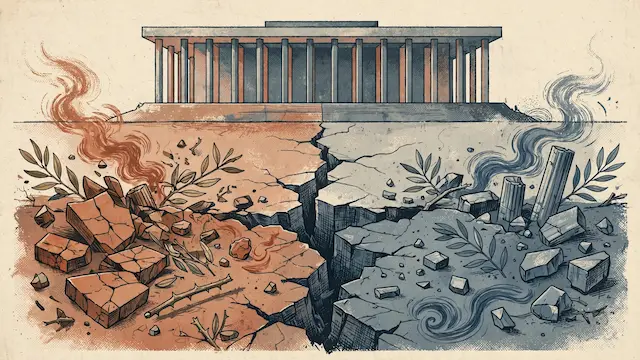
The current political struggle in Israel is not merely a parliamentary dispute but rather an advanced stage of civil war between opposing ideological camps, according to author Ran Edelist. He argues that the side that lost the recent election is employing various forms of violence and disruption in an attempt to overturn the election results and create a security emergency that would benefit a transitional government. Edelist describes this strategy as cynical and a precursor to the security chaos the current government allegedly desires.
Edelist posits that certain operations are designed as collective punishment, knowing they will only strengthen resistance and lead to further terror attacks. He believes the scale of these operations cannot be understood as an effort to eliminate terrorism but rather as a deliberate attempt to create chaos that will hinder the formation of the elected government. He characterizes this approach as "Machiavelli on steroids" driven by a messianic ideology.
The core conflict, according to Edelist, is ideological: a clash between the right, which he defines as a state for its Jewish citizens and in a process of redemption and religious observance, and a liberal-democratic left that champions freedom of expression and acceptance of others. He asserts that these two ideologies cannot coexist without an agreed-upon ceasefire and separation into autonomous entities.
Edelist suggests that if Netanyahu and his allies are removed from leadership, they will face numerous criminal investigations. He anticipates an "endless series of AI leadership exercises" from Netanyahu, including threats, bribery offers, and fabricated scandals. He advises dealing with this situation through patience, utilizing legislative majority for immediate needs, and addressing violent incidents with the support of the achieved majority, noting that Ben Gvir mobilized Arab voters and Netanyahu formed an Arab-Jewish front in the Knesset.
He criticizes the idea of reversing Israel's progress, stating that the previous right-wing government was a "wild continuation" of past eras that allowed messianic, violent, and corrupt factions to flourish. Edelist expresses doubt that the current "change government" is focused on necessary change, suggesting that life's circumstances might eventually guide it toward a path that rejects violent nationalism in favor of inclusivity, first with Israel's Arab citizens and then with Palestinians. He indicates that true normalization will only occur when Israelis can freely purchase goods and services in Palestinian cities like Nablus, Jenin, Hebron, and Ramallah.