
New Knesset Member Urged to Work Within Parliament for Unity
Translated & summarized from Kipa by baba
New Likud MK Elisha Mardan, who lost his legs in service, is campaigning for national unity by sleeping in a tent outside the Knesset. Critics argue that while his intentions are sincere, he should use his parliamentary position to negotiate and legislate for unity from within the Knesset, rather than relying on external symbolic gestures. His efforts are seen as bypassing the difficult political work required to achieve unity, which is his mandate as an elected official.
The story in 5 lines · by baba
- MK Elisha Mardan is urged to work for national unity from within the Knesset, not outside it.
- Mardan, who lost legs in service, has set up a tent in Jerusalem for his unity campaign.
- Critics argue his external actions undermine his role as a coalition MK.
- Achieving political unity requires negotiation and compromise within parliament, not just public appeals.
- His parliamentary tools should be used to build alliances and initiate legislation for unity.
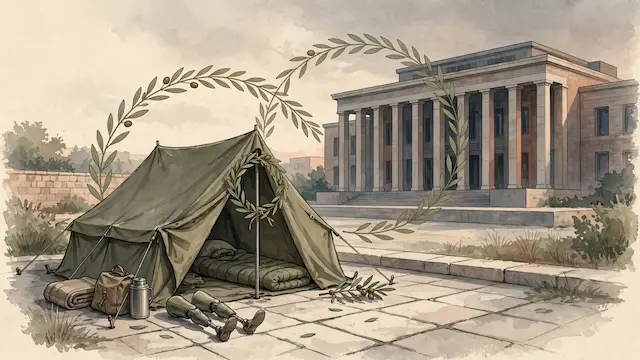
Elisha Mardan, a newly elected Member of Knesset (MK) for the Likud party, is being urged to leverage his parliamentary position to advance his goal of national unity, rather than relying solely on public demonstrations. Mardan, who lost both legs serving in the Israeli military, has set up a tent in Jerusalem as part of a campaign for a unity government. While his sincerity and personal sacrifice are acknowledged, critics argue that his approach misses the mark.
As an MK, Mardan has access to political and parliamentary tools that could be used to foster dialogue, build alliances, and initiate legislation from within the Knesset. The article suggests that focusing on external media events, like his "Unity Tent," detracts from his potential to effect change through direct engagement with other lawmakers and the Prime Minister. This is particularly relevant as Mardan was placed on the Likud list through a reserved spot, not through primary elections.
His current tactic is compared to past instances where opposition MKs established "Knesset outside the Knesset" to protest government actions. However, the article distinguishes Mardan's situation as a coalition MK seeking to promote a political change, arguing that operating outside the parliament undermines his credibility and signals a lack of faith in his ability to influence policy from within. The author contends that Mardan should be using his access to coalition partners and potentially other parties to build a political movement for unity, rather than settling for symbolic gestures.
The piece questions the nature of the "unity" Mardan seeks, noting that while a broad government is an appealing slogan, achieving political unity requires practical work, negotiation, and compromise. By operating outside the Knesset, Mardan remains in the realm of principled agreement and public declarations, bypassing the difficult stage of translating ideas into political reality. The article concludes that Mardan's determination should be channeled into the parliamentary corridors and political discussions, where his true impact will be measured, rather than in symbolic acts like sleeping in a cold tent.



