
US Aviation Crisis: 20,000 Flights Canceled Amid System Failures
Translated & summarized from Ice by baba
A week of severe disruptions in U.S. aviation, triggered by a critical air traffic control system failure, led to 20,000 flight cancellations and a nationwide ground stop. The incident, caused by routine maintenance, highlighted aging infrastructure and prompted a $50.1 billion funding request for modernization, which faces political opposition. The crisis impacted Israeli travelers with connecting flights and is expected to increase airfare costs.
The story in 6 lines · by baba
- A critical FAA system failure caused 20,000 flight cancellations and a nationwide ground stop in the U.S.
- Routine maintenance work on routers led to a data surge, disabling air traffic control communication.
- The U.S. government requested $50.1 billion for aviation infrastructure upgrades following the widespread disruptions.
- Congressional leaders expressed opposition to the full funding request, seeking a more limited budget.
- The crisis significantly impacted Israeli travelers, causing delays and forcing rebookings.
- Airlines estimate $345 million in lost profits, with potential future fare increases for consumers.
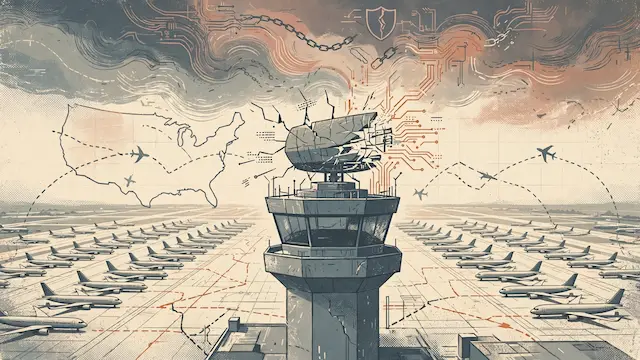
A cascade of infrastructure and computer glitches crippled U.S. airports over a recent week, leading to approximately 20,000 flight cancellations and reigniting debate over the state of air traffic control systems. On Friday, the Federal Aviation Administration (FAA) ordered a nationwide ground stop, an unprecedented event since 9/11. This halt transformed terminals into makeshift refugee camps for hundreds of thousands of stranded passengers as officials scrambled to understand how routine maintenance caused the national air communication network to collapse.
The crisis began on Thursday, November 12, with a warning sign as the Trump administration requested an additional $30.1 billion from Congress for aviation infrastructure modernization. The same day, a major outage affected Microsoft 365 servers nationwide, highlighting digital vulnerabilities, though flights continued to operate.
The critical failure occurred Friday, November 13, during routine work to replace copper cables with fiber optics in Arkansas and Texas. A data surge in control center routers led to a loss of communication and radar data. While about 3,500 airborne flights landed safely, the FAA froze all departures nationwide, resulting in nearly 19,500 cancellations.
In the following days, the ripple effect paralyzed airlines. Thousands of crew members and aircraft were stranded. The FAA, as a precaution, disabled the problematic function on 60 routers nationwide. On Monday, November 16, United Airlines experienced an internal computer malfunction affecting its system for calculating aircraft weight and balance, delaying over 100 flights. By Tuesday, November 17, Transportation Secretary Sean Duffy and FAA Administrator Byron Bedford updated the budget request to $50.1 billion before lawmakers, while the faulty router was sent for FBI examination, though a cyberattack was deemed unlikely.
Congressional opposition emerged by Wednesday, November 18, with lawmakers questioning the full funding request and noting that only $1 billion of $12.5 billion previously approved had been utilized. In response, the FAA halted the installation of new routers and reverted to a limited, conservative operational mode. Airlines implemented flexible rebooking policies for passengers. However, a permanent solution is stalled in Washington politics. The proposed $50.1 billion plan includes radar and software upgrades, new regional control centers, tower renovations, and runway and terminal expansions. Senate Commerce Committee Chairman Ted Cruz indicated that Congress would not grant a "blank check," anticipating a reduced budget focused solely on critical control system replacements.
For Israeli travelers, the crisis has significant implications, particularly for connecting flights through major U.S. hubs like Newark and JFK, which were heavily impacted. Israeli passengers faced cancellations and lengthy waits or long-distance car rentals. U.S. law does not mandate compensation for FAA-caused delays or cancellations, unlike Israeli or European regulations, though airlines must rebook or refund passengers. Travelers are advised to allow ample connection time, book flights under a single reservation, and utilize airline apps for rebooking during disruptions. The crisis is expected to cost airlines an estimated $345 million in lost profits and could lead to increased airport taxes, security fees, and base ticket prices in the coming year as airlines and the FAA seek to cover modernization costs.
Mentioned



