
Author Argues Political Chaos Necessitates Unity Government
Translated & summarized from Israel Hayom by baba
An author argues that Israel's current political chaos stems from public exhaustion with conflict, advocating for a unity government to heal societal divisions. He criticizes minority governments and the "Anyone but Netanyahu" slogan, stressing the need to address the deep rift between right and left. The proposed unity government would aim to unify the nation and move past the current political stalemate.
The story in 6 lines · by baba
- Author advocates for a unity government to address Israel's political chaos and public exhaustion.
- He criticizes minority governments and the "Anyone but Netanyahu" slogan as insufficient solutions.
- The core issue is Israel's deep division between right and left, not just Netanyahu's leadership.
- A unity government is presented as the only path to healing and national reconciliation.
- The public is described as weary of constant conflict and seeking a resolution.
- Member of Knesset Ahmed Tibi was reportedly shouted at by bereaved parents during a speech.
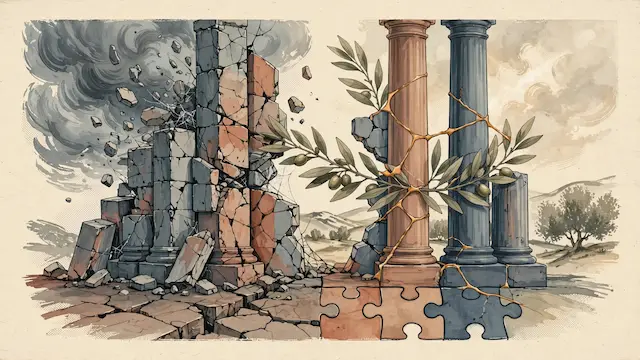
The author suggests that the current political chaos in Israel, characterized by coalition-building efforts, is a sign that the public is weary of constant conflict. He posits that the only government that can truly align with the nation's spirit and will is a unity government.
This proposed unity government would aim to provide minimal political contribution to the public's exhaustion from ongoing struggles. The author criticizes single-sided governments, including minority governments that rely on Arab and Haredi factions, stating they do not offer a genuine solution or healing for the nation.
He emphasizes that the only remedy politics can offer the Israeli discourse and society is a unity government that dissolves all boycotts. Such a government, he argues, must accept Prime Minister Netanyahu and the remainder of his term, understanding that the public's fight is for their voice and vote, not solely against Netanyahu.
The author contends that a minority government fails to address Israel's core problem: the dichotomous division between right and left, or "Bibi-ists" and "Kaplan-ists." He believes that only when this understanding permeates will healing begin, rendering the question of who is right irrelevant.
He asserts that the majority of Israelis are tired of incessant disputes and wish to move past the question of "Whose Israel is it?" The author criticizes leaders of the "change bloc" for being tempted by the simplistic slogan "Anyone but Netanyahu," suggesting the public has moved beyond this.
He concludes by stating that if mistakes were made, they should be corrected, and that the focus should be on finding solutions rather than perpetuating conflict.
Mentioned



