
Six Detained in Israel for Illegally Excavating Ancient Water Cistern
Translated & summarized from NEWSru Israel by baba
Six individuals were arrested by the Israel Antiquities Authority for illegally excavating an ancient water cistern near Mevaseret Zion in the Judean Hills. The suspects, who were posing as picnickers, used tools including a jackhammer to search for treasures in the Khirbet Adash site. The unauthorized digging caused significant damage to the reservoir and surrounding historical layers. Authorities believe social media stories about hidden treasures are fueling such illegal activities, which carry a potential five-year prison sentence.
The story in 6 lines · by baba
- Six individuals were arrested by the Israel Antiquities Authority for illegal excavations.
- The suspects were digging for treasures in an ancient water cistern at Khirbet Adash.
- The illegal digging caused irreparable damage to the historical site.
- Tools including a jackhammer and generator were found with the suspects.
- The IAA head cited social media treasure stories as a motive for such crimes.
- Israeli law carries a penalty of up to five years for damaging antiquities.
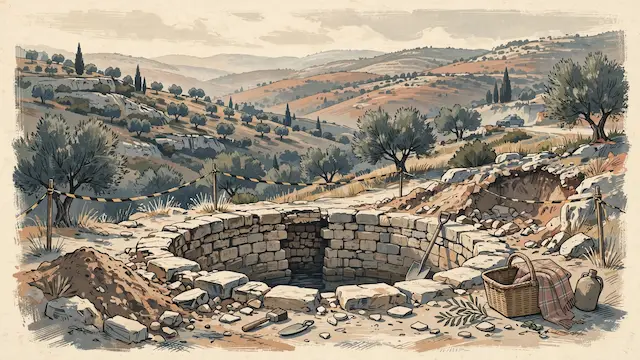
Inspectors from the Israel Antiquities Authority (IAA) apprehended six individuals suspected of conducting unauthorized archaeological excavations in the Begin Park area, near the settlement of Mevaseret Zion in the Judean Hills. The suspects were reportedly attempting to find treasures within a roughly nine-meter-deep ancient water reservoir at the Khirbet Adash archaeological site. The operation took place over the past weekend. Some of the detainees had descended into the reservoir to dig, while others remained above ground near a campfire, creating the appearance of a picnic. Authorities discovered a generator, an electric jackhammer, power drills, digging tools, a long ladder, and lighting equipment among the suspects. Inside the cistern, archaeologists found fragments of hundreds of pottery vessels from various eras, several stone artifacts, and a fragment of a vessel with an animal-shaped spout, dating to the early Islamic period. Specialists believe the large number of finds indicates the reservoir ceased being used for water storage in antiquity and was instead converted into a refuse pit.
Khirbet Adash is an archaeological site with remains of a settlement that existed from the 1st century BCE, during the Second Temple period, until the 8th century CE. Previous discoveries at the site include a ritual bath (mikveh) with two entrances, remnants of residential and public buildings, water systems, industrial facilities, and an early Islamic mosque. The IAA stated that the illegal excavations caused irreparable damage to the site, including the destruction of the reservoir's walls and floor, and the disruption of preserved plaster layers. Archaeologists suspect the detainees were searching for hidden valuables.
Dr. Amir Ganor, head of the IAA's Antiquities Robbery Prevention Unit, noted that stories about treasures allegedly hidden at archaeological sites are circulating on social media. He explained that such narratives encourage illegal digging, which destroys ancient cultural layers and vital historical information. The six suspects were taken for police questioning, and the case will be forwarded to the prosecution for potential charges. Israeli law stipulates a penalty of up to five years imprisonment for damaging an archaeological site.
Mentioned
The same event, reported separately by each outlet. Open a few to compare what different newsrooms emphasize — and what they leave out.
Other 2
