
Dutch Jewish Family Defies Hate by Flying Israeli Flag Amidst Protests
Translated & summarized from Mako by baba
A Jewish family in Amsterdam is flying an Israeli flag from their home, drawing attention and facing hostility amidst rising anti-Semitism in the Netherlands. Dutch-Jewish activists report increased incidents affecting schools, workplaces, and cultural institutions, with a recent large anti-Israel march drawing thousands. Legal experts note that while hate speech is not protected, Dutch law broadly permits expression, complicating enforcement against pro-Hamas sentiment. The family's act is seen as a courageous stand against a climate of demonization and a perceived lack of official action.
The story in 5 lines · by baba
- A Jewish family in Amsterdam is flying an Israeli flag, facing hostility amidst rising anti-Semitism.
- Dutch-Jewish activists report a significant increase in anti-Semitic incidents affecting various aspects of life.
- A large anti-Israel march in Amsterdam drew thousands, with estimates varying between organizers and community leaders.
- Dutch law's broad protection of free speech complicates enforcement against pro-Hamas sentiment.
- The family's defiant act is seen as a courageous stand against hatred and perceived official inaction.
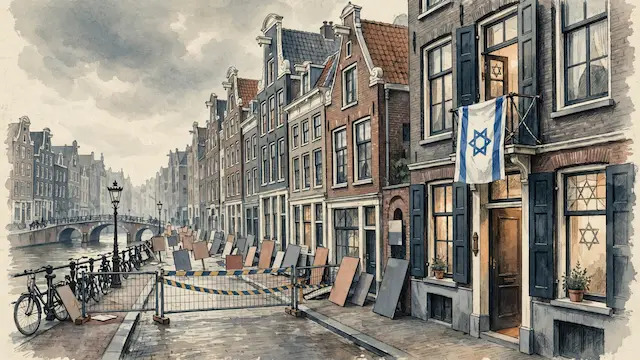
A prominent Israeli flag flying from a home in Amsterdam has become a symbol of defiance against a rising tide of anti-Semitism in the Netherlands, according to Dutch-Jewish community members. The family, located on the major thoroughfare of Overtom Street, has faced hostility and threats for displaying the flag, particularly during a large "Red Line" march in Amsterdam last week, which organizers claimed drew up to 200,000 participants, though local Jewish community estimates range from 70,000 to 90,000.
Dutch-Jewish lawyer David Mock, who has lived in the country for 30 years and fought anti-Semitism for over two decades, described the march's attendees as a mix of older Dutch citizens, anti-Zionist Jews, and Hamas supporters. He noted that such protests, often organized and funded by far-left groups and NGOs, have become more frequent as the Palestinian issue gains media attention. Mock highlighted a significant increase in anti-Semitic incidents in recent months, affecting various aspects of life, including schools, universities, and workplaces.
Rachel Levy, chairwoman of the Jewish community in Utrecht, stated that the current atmosphere is part of a deeper, long-standing anti-Semitism in the Netherlands that has resurfaced since the Holocaust and intensified since October 7th. She pointed to a concerning coalition between Muslim immigrants in major cities and the Dutch left, which has made opposition to Israel a mainstream stance. Levy described a pervasive sense of demonization, with a blurring of lines between anti-Israel sentiment and anti-Semitism, impacting the cultural sphere, leading to rejections of Jewish authors and musicians, and a sharp decline in visitors to the Jewish Museum.
Dutch lawyer Roy D. Benet explained the legal complexities, noting that Dutch law offers broad protection to freedom of expression and assembly. While criticism of Israel, sanctions demands, or accusations of genocide are not inherently criminal, even general public support for Hamas, designated a terror organization, is not automatically illegal under current law, though legislative changes are being considered. Benet emphasized that freedom of speech is not unlimited and does not protect incitement to hatred or violence, threats, or insults, where the responsibility falls on local authorities to enforce public order.
Despite these challenges, the family's decision to keep the Israeli flag flying is seen by some as an act of courage in a city where anti-Israel demonstrations have become commonplace. While some Jews choose to conceal their identity, others, like this family, use symbols like the flag to stand firm against what they perceive as escalating hatred and a lack of adequate response from authorities.
The same event, reported separately by each outlet. Open a few to compare what different newsrooms emphasize — and what they leave out.
Coverage from Mako

Not the same event — other stories that share this one’s people, places, or theme: background, reactions, and follow-ups.

