
Israel's Housing Market Sees Price Drops, Ministry of Finance Warns
Translated & summarized from Maariv by baba
Israel's housing market is facing falling prices and a significant shift in its construction labor force, according to the Ministry of Finance. The number of foreign workers has nearly tripled since the war, while local employment has decreased. The ministry warns of a slowdown in construction activity and recommends re-evaluating the policy on increasing foreign worker quotas due to potential impacts on local employment.
The story in 5 lines · by baba
- Israel's housing market is experiencing price drops, signaling a potential downturn.
- The construction sector has seen a nearly threefold increase in foreign workers since the war.
- Local employment in construction has declined significantly, raising concerns for Israeli workers.
- The Ministry of Finance recommends reassessing the policy on foreign worker quotas.
- A slowdown in construction activity is indicated by fewer new projects and more unsold apartments.
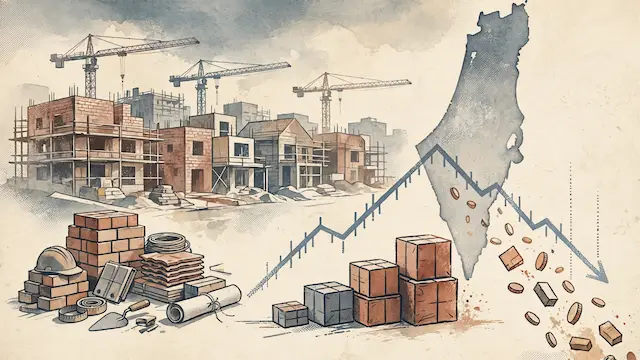
Israel's housing market is experiencing a downturn, with prices falling and the Ministry of Finance identifying further warning signs. Data reveals a significant shift in the construction sector: the number of foreign workers has nearly tripled since the war began, while local employment has declined. In the second quarter of 2026, approximately 352,000 workers were employed in the sector, a decrease from a peak of around 387,000 in late 2025. This drop was primarily driven by a reduction in local workers, falling by about 17% from late 2025 to the first half of 2026, though a partial recovery was seen by September.
The composition of the workforce has dramatically changed. Palestinian workers, who numbered around 109,000 before the war, plummeted to about 6,000 in late 2023 and only 21,000 by the second quarter of 2026, reducing their share of the workforce from 31% to 6%. Concurrently, foreign workers increased by approximately 59,000, from 30,000 pre-war to 89,000 in the second quarter of 2026, nearly tripling their representation to 26%. This surge in foreign workers is partly attributed to government policy aimed at addressing labor shortages caused by the halt in Palestinian worker entry. Foreign workers also averaged about 48 hours per week, compared to 37 for Israeli workers and 41 for Palestinian workers.
Employment of Israeli Arabs also saw changes, initially increasing post-war but declining in 2026. The Ministry of Finance suggests the decrease in employment isn't solely due to workforce composition shifts but also indicates a slowdown in construction activity. This slowdown is evidenced by a drop in new construction starts, a rise in unsold new apartments since 2022, and potential cash flow difficulties for some contractors. These developments may signal a reduced demand for labor, even as foreign worker numbers grow.
Given the decline in local employment and signs of a cooling market, the Ministry of Finance's chief economist recommends re-evaluating the policy of increasing foreign worker quotas in construction. The ministry emphasizes the need to consider the potential impact of expanded foreign labor on local employment opportunities.
Mentioned


