
Hezbollah's Arsenal Has Devastated Lebanon's Shiite Heartland
Translated & summarized from Zman Yisrael by baba
Lebanon's Shiite community is increasingly questioning Hezbollah's role and the purpose of its weapons, which have led to widespread destruction and displacement. The World Bank estimates $14 billion in damages from the 2023-2024 conflict alone. Critics, like Sheikh Muhammad al-Haj Hassan, call the situation a "true Nakba," arguing Hezbollah's military choices have harmed the community it claimed to protect. This internal reckoning highlights a growing distinction between Hezbollah and the Shiite populace, as residents question the sacrifices made for the organization's continued armament.
The story in 5 lines · by baba
- Lebanon's Shiite community questions Hezbollah's weapons, which have caused destruction and displacement.
- The 2023-2024 conflict caused an estimated $14 billion in physical damage and economic losses.
- Sheikh Muhammad al-Haj Hassan calls the situation a "true Nakba" for the Shiite community.
- Critics argue Hezbollah's weapons have turned Shiite areas into perpetual conflict zones.
- An anonymous activist stated, "Hezbollah is not the community, and the community is not Hezbollah."
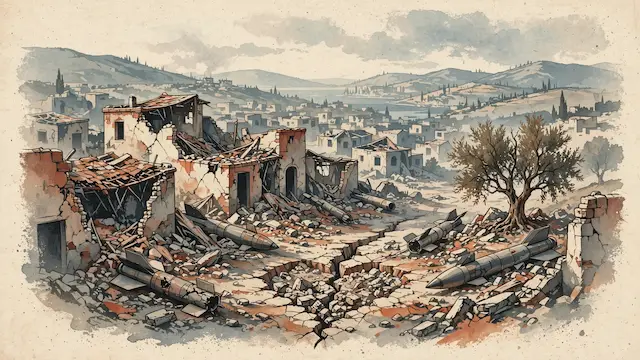
Increasingly, voices within Lebanon's Shiite community are questioning the purpose of Hezbollah's arsenal, which was long presented as a shield for southern Lebanon. Since Hezbollah opened the Lebanese front in solidarity with Gaza on October 8, 2023, the region has suffered extensive destruction, displacement, and economic hardship. The World Bank estimates physical damage and economic losses from the 2023-2024 conflict alone at $14 billion, with the Nabatieh and South Lebanon governorates bearing the brunt. Reconstruction needs are estimated at $11 billion.
Within the Shiite community, a profound reckoning is underway. Sheikh Muhammad al-Haj Hassan, head of the "Free Shiite Current" and a vocal critic of Hezbollah, described the situation in 2024 as a "true Nakba" for the Shiite community, questioning what Hezbollah's weapons had achieved for Shiites and Lebanese, concluding "zero and nothing." He stated that Lebanon had moved from an adventure to a gamble with its fate.
This sentiment has intensified, particularly after Lebanon was drawn into another severe conflict in March 2026. From within Shiite strongholds, accusations arose that Hezbollah's military decisions imposed costs on others. Over a million people were displaced, many of them Shiites from the south, Beqaa, and Dahieh. The Washington Post reported in March a decline in support for Hezbollah among its traditional Shiite base, fueled by anger over the decision to engage in further conflict.
Critics argue that Hezbollah's weapons, intended as a security policy for Shiites, have instead turned their living areas into perpetual conflict zones. An anonymous Shiite activist from the south noted on X that Hezbollah chose to invest in tunnels, weapons, and wars instead of human development, agriculture, infrastructure, and the future. This activist stated, "Hezbollah is not the community, and the community is not Hezbollah," highlighting a growing distinction between the organization and the Shiite populace.
While this criticism does not signify a collapse of support for Hezbollah, as it retains a significant base and lacks an organized Shiite alternative, the discourse is shifting. Many Shiites now question the sacrifices demanded for Hezbollah to maintain its weaponry. Although Israel is seen by many Shiites as responsible for destruction through its attacks, and human rights groups have criticized Israeli policies, these critics also hold Hezbollah accountable for repeatedly turning their homeland into a front for struggles beyond Lebanon's borders. The question now is what remains of southern Lebanon after four decades tied to Hezbollah's arms.