Israeli Unity Government Talks Stall Amid Leadership Dispute
Translated & summarized from Jüdische Allgemeine by baba
Negotiations for an Israeli unity government are stalled due to a leadership dispute between Benjamin Netanyahu and Gadi Eisenkot, who is tasked with forming the government. Eisenkot refuses to allow Netanyahu to serve as prime minister first, and Netanyahu insists on leading. Talks with ultra-Orthodox parties are ongoing but difficult, while the opposition bloc seeks Knesset influence through key appointments. A resolution remains unlikely as both leaders hold firm on the premiership.
The story in 5 lines · by baba
- Benjamin Netanyahu and Gadi Eisenkot are in a stalemate over who will serve as prime minister in a potential unity government.
- Gadi Eisenkot, tasked with forming a government, is negotiating with ultra-Orthodox and Arab parties.
- Netanyahu's Likud party is reportedly willing to form a government without Itamar Ben-Gvir's party.
- The anti-Netanyahu bloc is seeking to increase its influence by taking over key Knesset positions.
- Significant differences remain with ultra-Orthodox parties on conscription and religion-state issues.
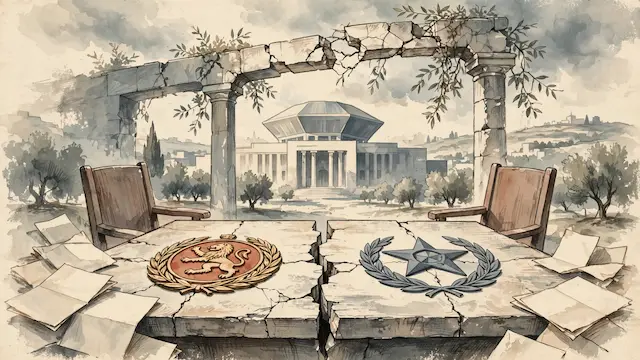
Negotiations for a potential Israeli unity government are progressing slowly, with representatives from Likud and Gadi Eisenkot's National Unity Party scheduled to meet. However, significant disagreements persist, particularly regarding the premiership. Benjamin Netanyahu insists on leading any new government, while Eisenkot refuses to cede the prime minister role to him. Eisenkot is also unwilling to negotiate a rotation for the top position, according to Israeli media reports.
The upcoming meeting will involve negotiation teams, with no personal encounter between Netanyahu and Eisenkot currently planned. Netanyahu had publicly offered to meet Eisenkot without preconditions, but Eisenkot's camp views this as a tactic to prevent an alternative majority coalition from forming. Eisenkot, who received the mandate to form a government from President Isaac Herzog, has offered Likud a place in a coalition led by him, but has ruled out cooperation with Itamar Ben-Gvir's Otzma Yehudit party.
Netanyahu continues to pursue a broad unity government under his leadership. While he did not explicitly state this condition in his recent offer, a senior Likud minister indicated that Netanyahu would expect to serve as prime minister first in any rotation. Likud appears to be banking on the possibility that Eisenkot's coalition-building efforts may fail, weakening his negotiating position and potentially lowering his demands.
Eisenkot is pursuing multiple strategies to secure a Knesset majority, with crucial talks underway with ultra-Orthodox parties, described by Eisenkot as having "more hidden than visible" aspects. Concurrently, his party is seeking agreements with Arab parties not for coalition participation, but for coordination on Knesset votes, including the replacement of the Knesset speaker and the appointment of key committee chairs to members of the anti-Netanyahu bloc.
Reports suggest Likud has signaled to Eisenkot that Otzma Yehudit's participation would not be a prerequisite for a deal, though Likud denies this. The focus for the opposition bloc remains on the ultra-Orthodox factions, where breakthroughs have been elusive, especially concerning conscription and the relationship between religion and state, with significant differences remaining. The possibility of a minority government relying on abstentions from Arab lawmakers is considered a last resort.
Meanwhile, the anti-Netanyahu bloc is working to increase its influence within the Knesset by seeking key positions currently held by Likud members. A vote for a new Knesset speaker is scheduled, with Matan Kahana of National Unity considered a strong candidate to replace Amir Ohana. The chairmanship of the Foreign and Defense Committee is also expected to change hands, potentially to Avigdor Liberman, replacing Boaz Bismuth. These personnel changes would significantly enhance the opposition's parliamentary influence and strengthen Eisenkot's position as he continues his search for a coalition majority.
Mentioned
The same event, reported separately by each outlet. Open a few to compare what different newsrooms emphasize — and what they leave out.
Centre 2

Not the same event — other stories that share this one’s people, places, or theme: background, reactions, and follow-ups.




