
US Midterm Election Results Threaten West Bank Settlements with Sanctions
Translated & summarized from Arutz Sheva by baba
A senior researcher warns that Democratic gains in the US Congress could lead to severe sanctions against West Bank settlements and Israeli financial institutions. Dr. Kobi Barada stated that settlers will face the harshest consequences, with potential actions including personal and regional sanctions. He also noted that President Trump might not be able to block all measures and that Israel must reassess its foreign policy amid shifting US political dynamics. Without a change in Israeli policy, Barada fears significant sanctions could be imposed.
The story in 5 lines · by baba
- Democratic gains in US Congress could lead to severe sanctions against West Bank settlements.
- Settlers in Judea and Samaria are expected to face the harshest consequences of the US election results.
- Sanctions could target Israeli financial institutions funding settlement construction and mortgages.
- President Trump may not be able to prevent all potential US actions against settlements.
- Israel must reassess its foreign policy due to the changing political landscape in Washington.
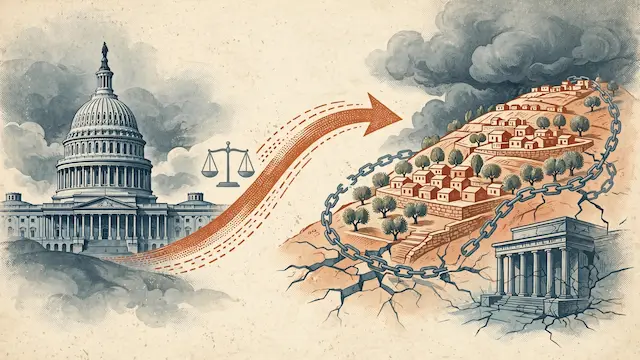
A senior researcher is warning that the Democratic Party's gains in the US Congress following the midterm elections could lead to severe sanctions against Israeli settlements in the West Bank. Dr. Kobi Barada, a senior researcher at the JPTI Institute, stated that settlers in Judea and Samaria will be the first to suffer the harshest consequences, describing the potential impact as "very painful." He anticipates that a Democratic majority in the House of Representatives, potentially by a hundred seats, and a Senate majority of 56 to 44 could result in significant measures against settlements, including actions targeting Israeli financial institutions that fund construction and mortgages. Barada cautioned that even President Donald Trump may not be able to or willing to prevent all such actions.
Barada characterized the Democratic victory as "biblical" in scale, noting unexpected gains even in traditionally Republican strongholds. He pointed to the US Ambassador's past remarks about "Jewish terrorism" in the West Bank as a potential basis for Democrats to advance harsher measures. These could include personal, regional, and spatial sanctions, potentially beginning as early as January 3rd when the new Congress convenes. Barada fears that sanctions on banks and financial institutions involved in settlement activities could effectively halt settlement expansion.
He also suggested that recent violent incidents by rioters in the West Bank have damaged Israel's international standing. Barada believes a new Israeli government demonstrating a change in enforcement policy might receive a grace period, but without such a shift, the impact on settlements could be immediate. He warned against relying solely on President Trump for protection, noting a developing trend within his circle to attribute Republican losses partly to Israel and US involvement in the Middle East. Barada cited comments attributed to Vice President J.D. Vance, which reportedly linked Republican failures to Israel and called for a change in bilateral relations, a sentiment echoed by Trump's son. This suggests that pressure is mounting on Trump, who may find it convenient to blame Israel for the defeat.
Barada concluded by emphasizing that regardless of whether Trump reduces his commitment to Israel, the political shifts in Washington necessitate that Jerusalem re-evaluate its foreign policy and relationships with other countries. He warned that without a change in policy and the formation of a new government with a different approach, the sanctions imposed could be extremely severe.
Mentioned


