
Israel's Oldest Missile Ship, INS Qeshet, Decommissioned After 44 Years
Translated & summarized from Maariv by baba
Israel's oldest missile ship, INS Qeshet, has been decommissioned after 44 years of service. The vessel, nicknamed "Submarine Hunter," returned to Haifa and is being dismantled for spare parts. A former commander highlighted its covert operations, including missions during the current war, and its unique anti-submarine capabilities. The ship's future is uncertain, with possibilities including becoming an underwater museum or a target.
The story in 5 lines · by baba
- INS Qeshet, Israel's oldest missile ship, was decommissioned after 44 years of service.
- The ship, nicknamed "Submarine Hunter," participated in covert operations, including during the current war.
- Its equipment will be used as spare parts for newer Sa'ar 4.5 class vessels.
- A former commander described its unique anti-submarine capabilities and operational challenges.
- The ship's future is undecided, with options ranging from museum display to being sunk as a target.
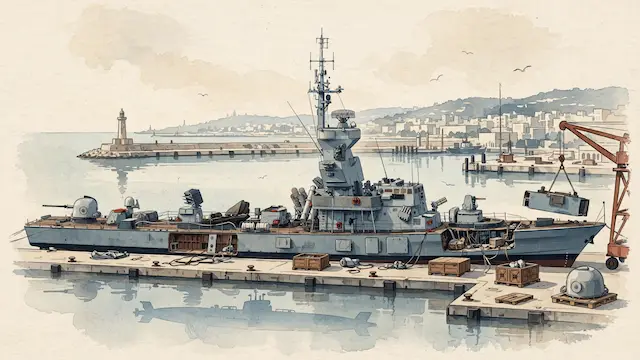
The Israeli Navy's oldest missile ship, INS Qeshet, has been decommissioned after 44 years of service. The vessel, nicknamed "Princess of the Flotilla" and "Submarine Hunter," returned to its homeport in Haifa for the last time ten days ago. Its crew is currently dismantling most of its equipment, which will be used as spare parts for the Sa'ar 4.5 class ships. The decommissioning marks the end of an era for the ship, which served in the First Lebanon War and underwent several upgrades to incorporate new weapon systems.
According to a former commander, identified as Lt. Col. 'A', the decision to retire INS Qeshet was driven by efficiency and the need to modernize the fleet. While the ship could have been refurbished, the cost and time involved, estimated at least a year in dry dock, made it less viable compared to acquiring new Reshef-class vessels. "She is already obligated to retire," Lt. Col. 'A' stated, noting that the ship had served twenty years beyond the typical 25-year lifespan for naval vessels.
Lt. Col. 'A' also reflected on the operational differences between INS Qeshet and newer Sa'ar 6-class corvettes, highlighting the increased intimacy and direct exposure to the elements on the older vessel. He acknowledged that while the Sa'ar 6 class has superior firepower, he believes the construction quality of INS Qeshet might ensure some of its components last longer. The ship's unique capabilities, particularly its anti-submarine warfare (ASW) systems, earned it the "Submarine Hunter" moniker, with Lt. Col. 'A' emphasizing that submarines in its operational area would have reason to be concerned.
During its service, INS Qeshet participated in numerous covert operations, including missions far from Israel's shores during the current war. Lt. Col. 'A' described the challenges of operating in secrecy, where crews would be cut off from communication for weeks and unable to disclose their mission details upon return. He recalled one specific operation in dense fog, far from Israeli coastlines, involving complex systems. The ship also played a role in various missions in Gaza and Lebanon, providing significant firepower, intelligence, and support capabilities.
As for INS Qeshet's future, Lt. Col. 'A' expressed a desire for the ship to be honored, ideally as an underwater museum for divers or displayed at the Navy Museum in Haifa. He stated that while he would follow orders if required to use the ship as a target, he hoped the Navy would grant it a dignified end. The final decision on its fate, whether to sink it or preserve it, will be made after the completion of its dismantling process.