
Egypt's Air Force: A Deep Dive into the Region's Largest Air Arm
Translated & summarized from Calcalist by baba
Egypt's Air Force is the largest in the Arab world, operating a diverse fleet of aircraft from multiple international suppliers to avoid foreign dependency. While possessing advanced capabilities and highly trained pilots, it notably lacks dedicated aerial refueling tankers, suggesting a defensive strategic posture. The EAF actively participates in international exercises, enhancing its operational experience and global cooperation.
The story in 6 lines · by baba
- Egypt's Air Force is the largest in the Arab world, operating a diverse fleet from multiple international suppliers.
- The EAF is estimated to have downed 15-30 Israeli aircraft in air combat over various wars.
- Egyptian pilots are highly skilled, benefiting from advanced, U.S.-assisted four-year training programs.
- A significant capability gap exists due to the lack of dedicated aerial refueling tankers.
- Future acquisitions may include Chinese J-10C fighter jets with advanced air-to-air missile capabilities.
- Egypt operates two helicopter carriers, enhancing its amphibious assault and troop deployment capabilities.
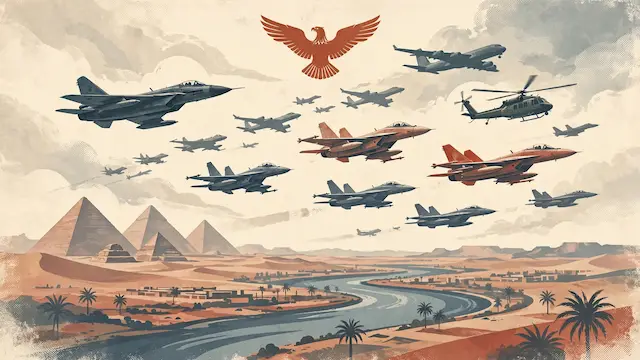
Egypt possesses the largest and oldest air force among Arab nations, established in 1928 and officially operational by 1930 with British-trained pilots. Initially focused on reconnaissance and support, it acquired dedicated fighter jets in 1938 and served alongside the British during World War II. During Israel's 1948 War of Independence, the Egyptian Air Force (EAF) engaged the Israeli Air Force (IAF) with similar aircraft, though Israel ultimately prevailed. Over the years, the EAF relied heavily on Soviet technology, notably the MiG-21, before shifting towards Western acquisitions following the peace accords with Israel, building a diverse and powerful force.
The EAF is estimated to have downed between 15 and 30 Israeli aircraft in air combat throughout various wars, with over 100 more lost to ground fire. Egyptian pilots are considered highly skilled, benefiting from advanced training developed with U.S. assistance, including a four-year pilot training program. While the EAF has extensive operational experience, particularly in counter-terrorism operations in Sinai and supporting campaigns in Yemen and Sudan, its bombing campaigns, such as the 2018 Sinai operation against ISIS, were less intense than those conducted by the IAF in Gaza in 2023.
Reflecting a strategy to mitigate foreign influence, the EAF operates a diverse fleet of aircraft from various international suppliers. Its fighter jet backbone includes American F-16s, French Rafales and Mirage 2000s, and Russian MiG-29M2s. This variety extends to training aircraft and a wide array of armaments, including French, U.S., and Russian anti-radiation missiles, ensuring flexibility and avoiding reliance on any single supplier. Future acquisitions are expected to include Chinese J-10C fighter jets, potentially equipped with advanced PL-15 missiles.
The EAF also boasts a substantial helicopter fleet, comprising advanced U.S. Apache and Russian Kamov 52 helicopters, alongside Mi-24 gunships and Gazelle helicopters. Its transport capabilities include U.S. Chinooks, Russian Mi-17s, and British-Westland Sea Kings. Egypt further operates two helicopter carriers, capable of deploying troops and providing air cover, though these vessels are not equipped for fixed-wing combat aircraft.
A notable deficiency in the EAF's capabilities is its lack of dedicated aerial refueling tankers, which significantly limits its ability to sustain prolonged bombing campaigns. While some MiG-29s possess limited buddy-to-buddy refueling capabilities, this is insufficient for large-scale operations. Egypt is reportedly seeking to acquire retired KC-10 tankers from the U.S., but the numbers are small relative to its fighter fleet. This strategic choice suggests Egypt is not planning large-scale offensive operations. The EAF actively engages in international cooperation through joint exercises like Bright Star with the U.S. and training with China, Turkey, and France, sharing expertise and gaining valuable insights into Western military practices.