
Taiwan Eyes Israeli Public Transport Projects, Challenging Chinese Dominance
Translated & summarized from Ice by baba
Taiwan has signaled its intent to enter Israel's public transportation market, particularly for the Gush Dan metro project and electric buses, challenging Chinese companies' previous dominance. Deputy Foreign Minister Francois Wu highlighted Taiwan's extensive experience in public transport, with Taiwanese firms potentially bidding on upcoming tenders worth billions. This move is seen as potentially gaining U.S. support, contrasting with recent exclusions of Chinese firms from Israeli infrastructure projects due to American pressure.
The story in 5 lines · by baba
- Taiwan seeks to enter Israel's public transport sector, challenging Chinese firms.
- Taiwanese firms may bid on Gush Dan metro operational system tenders worth $30 billion.
- Taiwan also eyes Israel's electric bus market through local manufacturers.
- U.S. pressure has reduced Chinese companies' role in Israeli infrastructure.
- Taiwan's Deputy Foreign Minister Francois Wu expressed interest in collaboration.
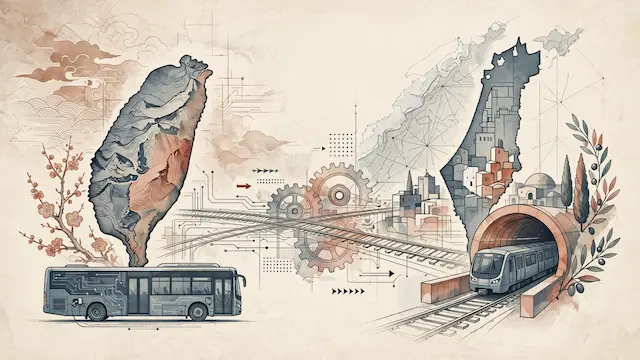
Taiwan has expressed interest in participating in Israel's public transportation projects, potentially challenging the long-standing dominance of Chinese companies in the sector. While Taiwan is globally recognized for its semiconductor industry, it also boasts advanced public transport systems, including high-speed rail, national rail networks, and metro systems. Taiwan's Deputy Foreign Minister, Francois Wu, stated in an interview with Globes that his country has significant experience to offer Israel in public transportation.
This Taiwanese interest comes at a crucial time as Israel advances its multi-billion dollar metro project in the Gush Dan region. Following the initial infrastructure tender selections, upcoming tenders worth approximately $30 billion will focus on the operational systems for trains and stations. Leading Taiwanese firms specializing in rail communication, traffic management, and related technologies may compete in these tenders, aiming to capture market share currently held by China. Taiwan is also looking to enter Israel's electric bus market through prominent local manufacturers.
The potential for Taiwanese involvement is partly due to a reduced Chinese presence in Israeli infrastructure projects. Previously, Chinese firms were dominant, involved in building the Red Line in Gush Dan and supplying its carriages, and holding a stake in its operator. However, U.S. pressure to limit Chinese influence in strategic infrastructure has led to Chinese companies being excluded from tenders for other major projects.
In contrast to China, Taiwanese participation is expected to receive support from the United States, a key ally of Taiwan. This strategic relationship is underscored by TSMC, Taiwan's chip giant, which produces over 90% of the world's advanced semiconductors. Taiwan's engagement in Israel's transport infrastructure could solidify these ties, making them more visible and tangible. Wu's visit to Israel in December was kept discreet due to Beijing's 'One China' policy, but Taipei emphasized shared democratic values.
Mentioned
The same event, reported separately by each outlet. Open a few to compare what different newsrooms emphasize — and what they leave out.
Other 2
