
Hezbollah Tightens Grip on Lebanon Amid Government Weakness
Translated & summarized from Maariv by baba
Hezbollah is expanding its influence and control within Lebanon by utilizing reconstruction funds, civilian institutions, and Iranian backing, while the Lebanese government struggles to assert its sovereignty. The organization operates health centers and engages in joint operations with the Lebanese army and other groups, even extending its reach to the Sunni population. Hezbollah has responded to challenges with threats, testing the Lebanese state's ability to enforce its decisions. A proposed strategy to counter Hezbollah's influence includes severing Iran's connection to the group and conditioning reconstruction aid.
The story in 6 lines · by baba
- Hezbollah is deepening its control over Lebanon through reconstruction funds and civilian institutions.
- Hezbollah's health centers operate with official government sanction, granting legitimacy.
- Lebanese soldiers have been seen working alongside Hezbollah-affiliated health and scout teams.
- Hezbollah is extending its influence to the Sunni population through allied associations.
- Hezbollah has responded to challenges with threats against Lebanese officials.
- A strategy to counter Hezbollah involves severing Iran's connection and conditioning aid.
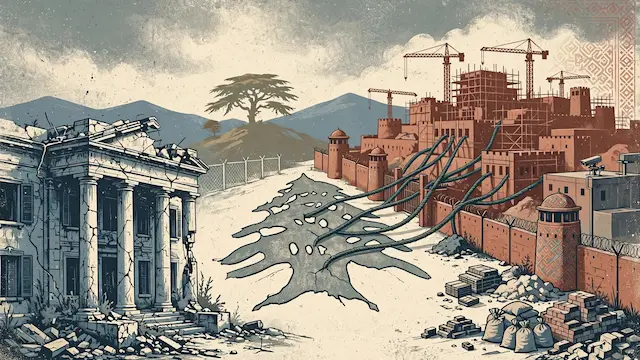
Hezbollah is deepening its control over Lebanon, leveraging reconstruction funds, civilian institutions, and Iranian support as the Lebanese government struggles to assert its sovereignty. The organization is increasingly operating under the guise of civilian and health organizations, often with official government sanction, which grants it legitimacy and fosters social dependency among Shia communities. For instance, the "Dar Al Houraa" health center in Beirut's southern suburbs, damaged during fighting, reopened in October 2026 under the patronage of the Lebanese Health Minister, Rakan Nasser El-Dine, who is aligned with Hezbollah. This center is operated by Hezbollah's "Islamic Health Organization."
Evidence from southern Lebanon, such as in the town of Faroun, shows Lebanese army soldiers working alongside Hezbollah's "Islamic Health Organization" and Amal Movement's "Al-Risala Scouts" teams during casualty evacuations. Hezbollah is also extending its influence beyond the Shia community, with the Sunni association "Kolna Wa Al Amal" in the Beqaa Valley operating in close ideological and political alignment with Hezbollah and Iran. This group collaborates with Hezbollah's "Wata'awano" association and holds joint events with the organization's women's activity unit, thereby increasing Hezbollah's sway among the Sunni population.
Hezbollah has responded to challenges with threats, including a Member of Parliament openly admitting a seized vehicle belonged to the organization and demanding the immediate release of detainees and the return of the vehicle and its contents. Despite these threats, the case was transferred to the Judicial Council, a special court for national security offenses, testing the Lebanese state's ability to enforce its decisions. A failure to conclude the investigation would further demonstrate its inability to exercise effective sovereignty.
The situation is further complicated by U.S. sanctions, which are now targeting political figures providing backing to Hezbollah, not just its operational arms. The seizure of C4 explosives in Cherbel and the subsequent transfer of the case to the Judicial Council, alongside warnings in the "Al-Akhbar" newspaper, signal a tangible threat to President Joseph Aoun and Prime Minister Nawaf Salam. Hezbollah is reportedly signaling to the leadership that any genuine attempt to enforce the law or advance security will be met with political assassinations and internal destabilization.
The current status quo, where the government is deterred by assassination threats, Hezbollah gains ground in the south under a civilian cover with government ministry sponsorship, and Nabih Berri continues his political maneuvers, serves neither Israel nor the United States. To counter Hezbollah's takeover or at least its strengthening and deepening influence, a combined strategy is proposed: ending the Iranian regime and severing Iran's connection to Hezbollah, conditioning reconstruction resources and reforms on Hezbollah and Amal's removal from project management and prohibiting government sponsorship of Hezbollah institutions, and launching a broad international campaign exposing Hezbollah's use of rescue organizations, civilian channels, and unauthorized presence of Revolutionary Guard commanders in Lebanon. The article concludes that a scenario of Lebanon descending into civil war concurrently with a campaign against Iran is plausible.