
Israel Proposes Major Public Transport Reform to Decentralize Control
Translated & summarized from Cursorinfo by baba
Israel is considering a major public transport reform to transfer authority from the Ministry of Transport to regional bodies in major cities like Jerusalem and Haifa. The proposed legislation aims to allow local control over routes and schedules to better meet passenger needs and reduce traffic. A key point of contention may be the operation of public transport on Shabbat, with the final outcome dependent on Knesset deliberations. This reform was previously considered in 2025 but did not pass.
The story in 6 lines · by baba
- Israel proposes a public transport reform to decentralize control to regional authorities.
- The reform aims to give local bodies power over bus routes, schedules, and frequencies.
- New transport authorities are planned for Gush Dan, Jerusalem, and Haifa initially.
- The operation of public transport on Shabbat could be a point of contention.
- A similar reform was approved by a Knesset committee in June 2025 but failed to pass.
- The "Yamina" party is pushing for the swift implementation of the proposed changes.
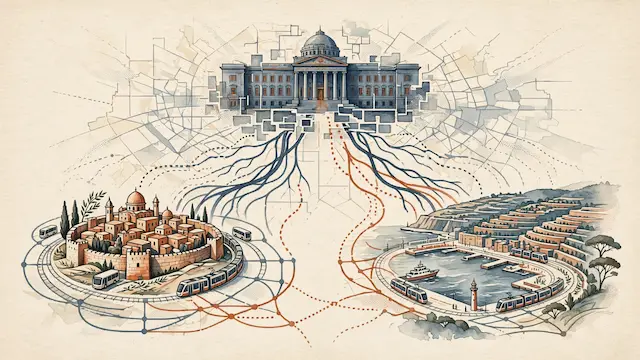
A significant reform of public transportation in Israel's major cities has been proposed, aiming to shift control over bus routes, schedules, and frequencies from the national Ministry of Transport to regional authorities. The initiative, spearheaded by Naftali Bennett, chairman of the "Yamina" party, seeks to empower local transport administrations to better address the needs of residents and potentially alleviate traffic congestion. The bill was introduced to the Knesset by Faction Chairman Eitan Ginzburg and MK Keren Turner, who previously served as Director-General of the Ministry of Transport.
If enacted, the reform would grant these new urban transport authorities the power to independently organize public transport within their regions. This includes revising bus routes, setting service frequencies, and adjusting timetables to respond more effectively to passenger flow and local conditions. The scope of their authority would also extend to planning bicycle infrastructure, managing traffic lights, and overseeing public transport traffic rule compliance. The reform also emphasizes improved integration between buses, trains, and other transit modes, aiming to create a more convenient network that serves as an alternative to private vehicles.
The initial phase of the reform plans to establish new transport authorities in Gush Dan, Jerusalem, and Haifa, with a subsequent rollout planned for the Beersheba region. In the Gush Dan metropolitan area, coordination between neighboring municipalities will be a key focus, allowing for unified planning that considers the entire agglomeration's needs rather than isolated settlements. This regional approach is expected to expedite decision-making processes regarding route and schedule adjustments.
A potentially contentious aspect of the reform is the operation of public transport on Shabbat. The proposal allows local authorities to consider local customs regarding weekend services. However, a previous version of the reform included a provision prohibiting municipal authorities from independently operating public transport on Shabbat, suggesting this issue could spark debate during the legislative process. The final form of the reform will depend on the Knesset's deliberations.
This is not the first attempt at such a reform; a similar initiative was approved by the Knesset's economic committee in June 2025 but did not reach a final vote. The bill has now been reintroduced to the 26th Knesset, which convened on November 10. Bennett has stated his party's commitment to advancing these changes without delay.
Mentioned
The same event, reported separately by each outlet. Open a few to compare what different newsrooms emphasize — and what they leave out.
Other 2

Not the same event — other stories that share this one’s people, places, or theme: background, reactions, and follow-ups.
