
Netanyahu's Unity Call Backfires, Deepening Political Divide
Translated & summarized from Behadrei Haredim by baba
Prime Minister Benjamin Netanyahu's speech calling for national unity at the Knesset swearing-in instead exacerbated political divisions. He attacked the possibility of a minority government supported by Arab parties, sparking protests and criticism from rivals like Gadi Eisenkot. Eisenkot called Netanyahu's speech "shameful" and reiterated his own call for an emergency government. The speech also targeted ultra-Orthodox parties, urging them to remain with Netanyahu's bloc, highlighting his struggle to retain support amid coalition formation challenges.
The story in 6 lines · by baba
- Prime Minister Netanyahu's Knesset speech calling for unity instead deepened political divisions.
- Netanyahu attacked a potential minority government supported by Arab parties, calling them "supporters of terrorism."
- Gadi Eisenkot called Netanyahu's speech "delusional, divisive, full of hate, and shameful."
- Eisenkot reiterated his call for an urgent national emergency government.
- Netanyahu urged ultra-Orthodox parties to stay with his bloc, warning them against joining Eisenkot's potential government.
- The political standoff continues with neither Netanyahu nor Eisenkot willing to meet the other's core conditions for government formation.
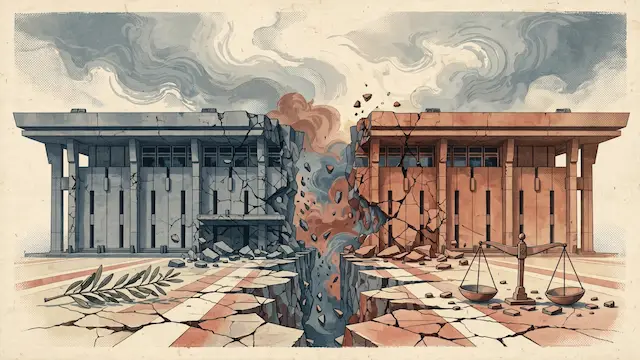
Prime Minister Benjamin Netanyahu's speech at the swearing-in of the 26th Knesset, intended to call for national unity, instead highlighted the deep political rifts in Israel. While initially echoing President Isaac Herzog's plea for compromise, Netanyahu's address quickly shifted to a strong critique of a potential minority government led by Gadi Eisenkot, which would rely on the support of Arab parties. Netanyahu accused these parties of denying Israel's right to exist as a Jewish state and warned against empowering groups he termed "supporters of terrorism."
The speech triggered immediate uproar in the Knesset. Yair Golan protested, MK Gilad Kariv was removed for interjecting, and Naftali Bennett questioned Netanyahu about the investigation into the October 7th events and Qatari advisors, drawing a heated response from Minister Itamar Ben-Gvir. The parliamentary session devolved into a political confrontation.
Gadi Eisenkot, who currently holds the mandate to form a government, sharply criticized Netanyahu's speech as "delusional, divisive, full of hate, and shameful." Eisenkot argued that Netanyahu misused the state event and reinforced his belief that the Prime Minister cannot continue in office, calling for an urgent national emergency government. Bennett succinctly stated, "This is not how you build unity."
Netanyahu's address also aimed to dissuade the ultra-Orthodox parties from joining a government led by Eisenkot, warning them that promises from the "change bloc" would not be kept. He pledged to work on legislation for the status of Torah scholars. This move indicates Netanyahu's effort to retain his right-wing bloc, as the departure of the ultra-Orthodox parties could fundamentally alter the political landscape.
The political complexities are evident in the Knesset numbers: Netanyahu's bloc has 53 seats, while Eisenkot has the support of 67 MKs but lacks coalition agreements. The core issue remains the differing visions for government formation. Netanyahu proposes a unity government under his leadership, including his current allies. Eisenkot, however, demands a break from "extremist" elements and adherence to his principles for joining a government led by him. Neither side has shown willingness to accept the other's key conditions, leaving the path to a stable government unclear.
Mentioned
The same event, reported separately by each outlet. Open a few to compare what different newsrooms emphasize — and what they leave out.
Centre 1Haredi 1Arab 1Other 1




Not the same event — other stories that share this one’s people, places, or theme: background, reactions, and follow-ups.




