
Cemeteries Warn of Grave Shortage, Seek Price Hikes
Translated & summarized from Ice by baba
Israeli burial societies have petitioned the High Court of Justice, warning of a severe shortage of burial plots and the inability to prepare for mass casualty events. They seek to raise plot prices to fund development, as current funding mechanisms are outdated and insufficient. Projects for 40,000 new plots are frozen, and existing capacity in major cemeteries could be depleted within years, impacting national emergency preparedness.
The story in 5 lines · by baba
- Israeli burial societies petition High Court over severe shortage of burial plots.
- Funding freeze threatens 40,000 new burial plots and emergency preparedness.
- Cemeteries warn existing capacity could run out within one to four years.
- Societies propose raising plot prices to fund necessary cemetery development.
- The October 7th attacks increased the need for emergency burial reserves.
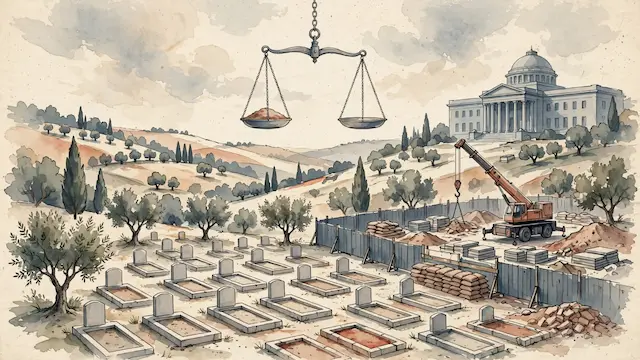
Israel's burial societies have petitioned the High Court of Justice (Bagatz) over a freeze on projects to establish 40,000 new burial plots, valued at over half a billion shekels. The societies warn that following the October 7th attacks, they are required to maintain thousands of emergency burial spaces, but a funding shortage threatens this reserve and the nation's ability to cope with mass casualty events like earthquakes. In some cemeteries, existing capacity is expected to run out within a year.
The petition argues that the state mandates expensive burial structures and assigns responsibility for maintaining emergency reserves but fails to update the funding mechanism it established. The Ministry for Religious Services' director-general has warned of halted development work and a compromised national emergency burial stock. The societies propose raising plot prices to approximately 35,000 shekels to fund cemetery development, a request the Ministry for Religious Services reportedly approved, though an election period delayed the final decision.
Key burial societies from Tel Aviv-Yafo, Jerusalem, Haifa, Rishon LeZion, and Petah Tikva joined the petition. They are demanding the Minister for Religious Services bring a directive to update burial plot purchase fees before the Knesset's Interior Committee for approval. The petitioners seek an urgent hearing due to fears of a severe shortage and compromised national emergency preparedness.
Following October 7th, authorities mandated that burial societies in Tel Aviv, Jerusalem, and Haifa maintain thousands of additional emergency burial plots. The societies contend that continued funding erosion and development halts will worsen the shortage and hinder emergency preparedness. In a mass casualty scenario, this could severely impede the state's ability to provide orderly burial services.
Data presented in the petition indicates that available plots in the petitioners' cemeteries will be depleted within one to four years, while constructing new burial structures takes about six years. Projects for approximately 40,000 plots have already been frozen in Tel Aviv and Haifa. In Jerusalem, projects for 8,000 plots are at risk of halting, and contractors at Har HaMenuchot have slowed or stopped work. Shortages are particularly expected in Or Yehuda within a year, and in Yarkon and Elad cemeteries within 1.5 years. Tel Aviv and Rishon LeZion face a shortage in about three years, and Haifa in about four years.
The core issue, according to the petitioners, is the state-defined funding model. The state assigned burial societies responsibility for cemetery development and new plot creation, with income from selling plots during a person's lifetime as a primary funding source. The government later mandated denser burial methods, requiring costly structures and tunnels. However, the fees, based on 1997 cost data, have not been updated to reflect rising construction and development expenses. The proposed fee update would increase the cost of purchasing plots but would not alter eligibility for free burial. For example, a draft directive suggests raising the maximum fee in Tel Aviv from about 19,000 shekels to approximately 34,900 shekels before statutory discounts. With accumulated discounts of about 40%, the cost would be around 20,952 shekels, compared to about 11,418 shekels currently. The societies emphasize these funds are for development, not profit.
The Ministry for Religious Services acknowledges the severity, with its director-general warning in October 2026 of halted development and risks to the national emergency stock, stating, "Every day of foot-dragging causes heavy damage to the burial system and the public in Israel." Despite professional support for the update, the ministry's hands are tied by a legal opinion advising against advancing the directive during elections.
Mentioned
The same event, reported separately by each outlet. Open a few to compare what different newsrooms emphasize — and what they leave out.
Centre 1Other 3



Not the same event — other stories that share this one’s people, places, or theme: background, reactions, and follow-ups.
