
Gaza Displacement Crisis Worsens as Storm Floods Shelters
Translated & summarized from Arab48 by baba
A recent storm in Gaza has caused widespread flooding of displacement camps, destroying tents and belongings and trapping families. Hundreds of thousands of displaced Palestinians are facing a worsening humanitarian crisis, with rescue teams overwhelmed and lacking resources. The storm has also caused collapses in buildings damaged by previous airstrikes, and health risks are increasing due to poor sanitation. International bodies are warning of the dire situation and calling for increased aid and better shelter.
The story in 6 lines · by baba
- A recent storm in Gaza flooded approximately 70,000 tents, exacerbating the humanitarian crisis for displaced Palestinians.
- Rescue teams are overwhelmed, having responded to only 218 of 2,166 distress calls due to limited resources.
- Buildings previously damaged by Israeli airstrikes have partially collapsed under the storm's impact.
- Health risks are escalating due to mixed sewage and rainwater in crowded displacement areas.
- The UN warns that aid supplies are insufficient to meet the growing needs of the displaced population.
- Women and girls, particularly female heads of households, face especially harsh conditions.
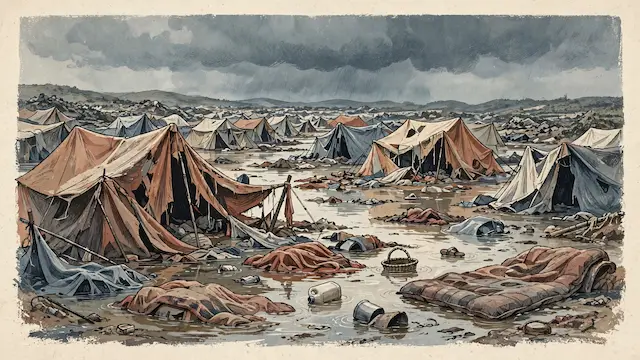
A recent low-pressure system in Gaza has exacerbated the humanitarian crisis for hundreds of thousands of displaced Palestinians, flooding their tents and destroying remaining possessions. Families have been trapped in makeshift shelters lacking basic protection, facing a struggle for survival akin to the devastation of airstrikes. Rescue teams are overwhelmed and lack essential equipment, fuel, and vehicles to cope with the storm's impact.
The Government Media Office reported that approximately 70,000 tents were inundated within 12 hours, with initial damages estimated at $3 million. Displacement camps and shelters sustained damage, and the storm caused walls and buildings already weakened by Israeli airstrikes to collapse.
Youssef Ajjisa, head of the International Committee to Break the Siege on Gaza, described the situation as a new form of "genocide" through disease, hunger, cold, and flooding, exacerbated by the ongoing blockade. He stated that survivors of airstrikes are now threatened by cold, disease, and lack of shelter and healthcare, highlighting the dire need for safe housing, food, clean water, and medicine.
The Civil Defense received 2,166 distress calls, but could only respond to 218 due to the sheer volume and limited resources. Water levels reached up to 1.5 meters in some areas, submerging residential areas and camps. Reports indicated that Civil Defense received around 1,500 calls in the initial hours of the storm alone.
Concerns are rising about the spread of infectious, intestinal, and skin diseases due to the mixing of rainwater with sewage and accumulated waste in crowded displacement areas. The healthcare system's capacity is further strained by shortages of medicine and medical supplies. Children, the elderly, the sick, and pregnant women are particularly vulnerable due to malnutrition, weakened immunity, and lack of heating, winter clothing, and adequate bedding.
Buildings damaged by Israeli airstrikes have also partially collapsed under the rain and wind, posing new dangers to residents seeking refuge in compromised structures. Partial collapses were reported in Nuseirat camp, Zeitoun neighborhood, and central Gaza City. Municipalities are struggling to clear water and manage debris due to a lack of fuel, equipment, and damaged infrastructure, including roads and sewage systems.
The UN Office for the Coordination of Humanitarian Affairs (OCHA) warned of the risks to displaced families, especially those in low-lying areas and damaged buildings. OCHA noted that available aid supplies are insufficient and called for the facilitation of winter supplies, heavy machinery, spare parts, and fuel. Previous UN estimates indicated that around 950,000 Palestinians live in areas at medium to high risk of flooding.
The Ministry of Women's Affairs highlighted the particularly harsh conditions faced by displaced women and girls, especially widows and female heads of households, due to flooded tents and shortages of dry shelter, bedding, food, and medicine. Approximately 258,927 displaced families reside in 2,090 shelters. The ministry called for rain-resistant tents, blankets, winter clothing, and the relocation of tents from flood-prone areas.
Ajjisa emphasized that temporary relief is inadequate, calling for exceptional international intervention to address the underlying conditions that make residents vulnerable. He urged the UN and international organizations to provide adequate temporary housing, repair water and sewage networks, and ensure the unimpeded flow of aid. Reports suggest that aid entering Gaza meets only about 18% of the required needs, with accusations against Israel for not adhering to agreed-upon arrangements for aid delivery.
Mentioned
The same event, reported separately by each outlet. Open a few to compare what different newsrooms emphasize — and what they leave out.
Haredi 1Arab 1

Not the same event — other stories that share this one’s people, places, or theme: background, reactions, and follow-ups.


