
US Strikes Iran Amidst Nuclear Talks, Internal Debate
Translated & summarized from Maariv by baba
President Trump confirmed a U.S. strike in Iran that destroyed an anti-aircraft system in minutes, while Iranian media reported explosions on Qeshm Island. The strike occurs amid internal debate within the Trump administration over renewing military action versus pursuing a diplomatic deal to curb Iran's nuclear program. Prime Minister Netanyahu reportedly supports further strikes, while Qatar attempts to mediate an agreement. The U.S. is also reinforcing its military presence in the Middle East.
The story in 6 lines · by baba
- President Trump confirmed a swift U.S. strike in Iran targeting an anti-aircraft system.
- The U.S. strike in Iran occurred amidst internal administration debate on military action versus diplomacy.
- Prime Minister Netanyahu is reportedly pushing for additional strikes against Iran.
- Qatar is attempting to mediate a potential agreement between the U.S. and Iran.
- The U.S. is increasing its military forces and assets in the Middle East.
- Explosions were reported in Iran's Qeshm Island following the U.S. strike.
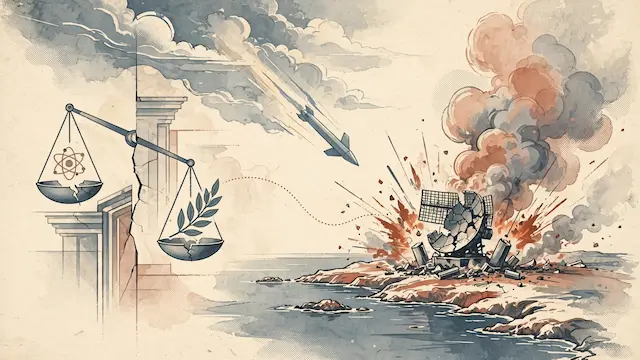
U.S. forces conducted a surprise strike in Iran, targeting a small anti-aircraft system that was destroyed within minutes, according to President Donald Trump. State media in Iran reported explosions on Qeshm Island in the Strait of Hormuz, with no immediate details on damage or casualties. This strike follows similar U.S. defensive actions in the region earlier in the week.
The attack carries significant political weight as it is the first U.S. strike in Iran since the Republican Party's midterm election losses. Inside the Trump administration, there is a division between officials advocating for renewed military action to pressure Tehran on its nuclear program and those favoring a diplomatic resolution. Some advisors reportedly believe further attacks are necessary to force Iran to abandon its nuclear materials, suggesting targets like energy, nuclear, and missile facilities.
This internal debate occurs against the backdrop of the Republican party's electoral defeat, which has strengthened the Democratic Party's position. President Trump faces a dilemma: escalating military action could increase public opposition, while a withdrawal or an agreement perceived as falling short of stated goals might be seen as a failure. The President has not made a final decision and is considering both diplomatic and military options, with economic difficulties in Iran and continued oil flow through the Strait of Hormuz also factors in his decision-making.
Meanwhile, Iranian officials are expected to return to Doha soon for discussions on a potential agreement. One proposal being considered is to drastically shorten the preliminary talks from 60 days to just two, allowing negotiations on the nuclear program to begin almost immediately. This could enable Trump to show rapid diplomatic progress and end the conflict without further military escalation, though Iran's acceptance is uncertain. Key disagreements persist over Iran's nuclear program, uranium enrichment, and the lifting of U.S. sanctions. Tehran reportedly seeks to resume oil sales and open the Strait of Hormuz before detailed nuclear discussions, while Trump insists any deal must resolve the nuclear issue.
The U.S. is also reinforcing its military presence in the Middle East, with the USS Theodore Roosevelt carrier strike group en route and an additional Marine expeditionary unit deploying. The U.S. has reportedly provided Israel with a Patriot air defense system and bolstered forces and equipment in the region to enable a rapid response if a decision for renewed conflict is made. Separately, U.S. Central Command announced a reward of up to $20 million for information on Iran's nuclear program.
President Trump is currently weighing three paths: renewed broad attacks to force nuclear concessions, continued sanctions to increase pressure, or advancing a deal through Qatari mediation. The limited strike in Qeshm illustrates the complex situation, with the U.S. continuing to use military force while avoiding a full-scale offensive, leaving open the question of whether these limited strikes will remain a pressure tactic or signal the start of a larger conflict.
Mentioned



