
Expert Suggests Iran Conflict Could Aid Netanyahu's Political Survival
Translated & summarized from Cursorinfo by baba
An expert suggests a potential conflict with Iran could politically benefit Israeli Prime Minister Benjamin Netanyahu by facilitating a national unity government. Journalist Dan Perry questions the necessity of such a military escalation, noting its timing with elections and its potential to keep Netanyahu in power despite unfavorable results. Past campaigns against Iran's nuclear program are cited as having limited long-term success. Perry stresses that any new military action requires strong intelligence justification to avoid appearing politically motivated, especially given Netanyahu's precarious political position.
The story in 5 lines · by baba
- An expert suggests a potential Iran conflict could help Prime Minister Netanyahu politically amid coalition talks.
- Journalist Dan Perry questions the necessity and timing of a new military campaign against Iran.
- A national unity government formed during wartime could allow Netanyahu to remain in power.
- Past military campaigns against Iran's nuclear program are noted for their limited long-term impact.
- Any new military action against Iran requires strong intelligence justification, according to the analysis.
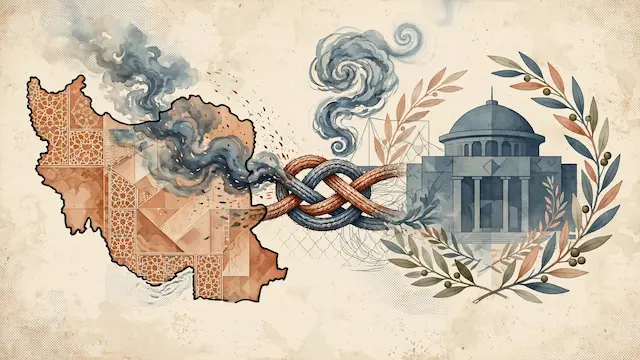
An escalation of conflict with Iran could potentially alter the political landscape in Israel and bolster Prime Minister Benjamin Netanyahu's position, according to an analysis published by Maariv. Journalist Dan Perry suggests that a new military confrontation with Tehran might facilitate the formation of a national unity government, thereby enabling Netanyahu to retain power despite unfavorable election results. Perry questions the necessity of another military campaign against Iran, noting the timing of discussions about a potential attack coinciding with elections in Israel and the US. He points out that opposition parties might feel pressured to join the current leadership during wartime, allowing Netanyahu to stay in office. This scenario is particularly relevant following recent elections, which presented Netanyahu with the prospect of losing power. A military escalation could also shift the political agenda, sidelining negotiations for an alternative coalition. The article also touches on the military viability of such operations, referencing past campaigns against Iran's nuclear program that, while claiming to weaken it, did not eliminate regional threats. It recalls a twelve-day war in June 2025 involving Israel and the US, which was followed by another campaign in February 2026 aimed at weakening the Iranian regime. Despite the elimination of Ali Khamenei and other officials, regime change was not achieved, and Iran demonstrated its ability to disrupt the global economy through actions like blockading the Strait of Hormuz. The ongoing threats from Houthis in the Bab-el-Mandeb Strait, as well as Hamas and Hezbollah, are also mentioned. Perry emphasizes that any new attack on Iran would require strong intelligence backing, such as evidence of accelerated uranium enrichment. Without such proof, a new war would raise questions about its true objectives, especially if perceived as a move to gain domestic political advantage. The article also notes the long-standing public distrust towards Netanyahu, citing past contradictions in his political stances and decisions. It highlights Gadi Eisenkot's potential to form a new government, which could end Netanyahu's tenure and alter national security decision-making. Ultimately, while a new conflict with Iran is possible, its justification must be based on clear security threats, not solely on domestic political interests, according to Perry.
Mentioned


