
US Midterm Election Results Spark Hysteria in Israel, Analysis Urges Calm
Translated & summarized from Makor Rishon by baba
Recent US midterm election results, which saw significant Republican losses, have caused an overreaction in Israel. An analysis suggests this is unwarranted, citing historical precedents of electoral shifts and emphasizing that most Americans maintain a positive view of Israel. The article attributes the Republican losses to economic factors, particularly rising fuel prices, and notes a growing isolationist wing within the Republican party and a leftward shift in the Democratic party. It calls for Israel to form a unity government to improve relations with the US, especially with Democrats, a strategy neglected under previous leadership.
The story in 5 lines · by baba
- US midterm election results have triggered an overreaction in Israel, with historical perspective suggesting it's unwarranted.
- Economic factors, especially rising fuel prices, are identified as the primary cause for Republican losses.
- Most Americans remain indifferent to the Middle East and hold a generally positive view of Israel.
- The US political landscape is shifting with a leftward trend in the Democratic party and an isolationist wing in the Republican party.
- Israel is urged to form a unity government to improve relations with the US, particularly with Democrats.
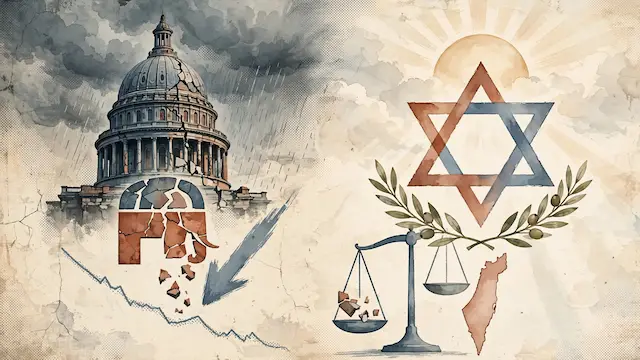
The recent US midterm elections, which saw significant Republican gains, have triggered an overreaction in Israel, with some declaring "America is lost." However, historical perspective suggests this is an overstatement. In 2010, Democrats lost 63 House seats, and Bill Clinton saw a loss of 54 seats in 1994. Donald Trump lost 40 seats in his first midterm election in 2018, a number similar to the recent outcome.
Despite the current narrative, the US has historically shown electoral flexibility. In 2020, the same year the US was engaged in intense fighting in Gaza amidst accusations of genocide against Israel, Americans elected a president who promised to support Israel more than his predecessor. The recent midterms saw Democrats win in traditionally Republican states like Kansas, Texas, and South Carolina, demonstrating this electoral fluidity.
The article attributes the Republican losses primarily to economic factors, specifically the significant rise in fuel prices over the past two years, impacting the cost of living. While trade wars initiated by Trump and the conflict with Iran are mentioned as contributing factors, the author asserts that Israel has not become a toxic brand in the US. Most Americans remain indifferent to Middle Eastern affairs unless directly affected and generally hold a positive view of Israel as a democracy.
However, the political landscape is indeed shifting. The Democratic party is experiencing a leftward shift, leading to the election of figures like New York City Mayor Eric Adams and Michigan Senator-elect Abdul El-Sayed. On the right, a more isolationist wing is emerging, with figures like Vice President J.D. Vance publicly questioning the US's relationship with Israel. This trend, exacerbated by social media propaganda and university discourse, is a cause for concern but not unprecedented.
In light of these election results, Israel is urged to adopt a more balanced approach. Instead of succumbing to paranoia or focusing on internal political disputes, particularly the protracted "Netanyahu or not Netanyahu" debate, Israel should form a broad Zionist unity government. This government should focus on improving its international standing, especially with the US, and re-establish ties with the Democratic party, a strategy that was neglected under Benjamin Netanyahu's previous policy of relying solely on Republicans. The author suggests that if Israeli voters cannot grasp this urgency, perhaps voters in Kansas and Texas can serve as a reminder.
Mentioned
The same event, reported separately by each outlet. Open a few to compare what different newsrooms emphasize — and what they leave out.
Centre 1Right 1Arab 1Other 1



Not the same event — other stories that share this one’s people, places, or theme: background, reactions, and follow-ups.



