
Dollar Surges Against Shekel to Near Year-High Amid Global and Local Uncertainty
Translated & summarized from Globes by baba
The Israeli shekel weakened against the US dollar, briefly reaching 3.22 shekels, its highest point in nearly a year. This decline is driven by global market drops, particularly in the US, and exacerbated by domestic political uncertainty in Israel following recent elections. Experts note that the shekel's weakness is also linked to an increased risk premium for Israel and potential shifts in US foreign aid. A resolution to the political uncertainty and stabilization in global markets are expected to help calm the currency.
The story in 6 lines · by baba
- The dollar briefly reached 3.22 shekels, its highest point against the Israeli shekel in almost a year.
- Global market declines, especially a 4-5% drop on Wall Street, are a primary driver of the dollar's rise.
- Domestic political uncertainty in Israel, stemming from government formation delays, is a significant factor weakening the shekel.
- Analysts report an increase in Israel's risk premium due to its standing in the US and domestic election outcomes.
- Potential expansion of the Abraham Accords with Saudi Arabia could strengthen the Israeli economy and the shekel.
- Stabilization in global markets and resolution of Israel's political uncertainty are key to calming the currency.
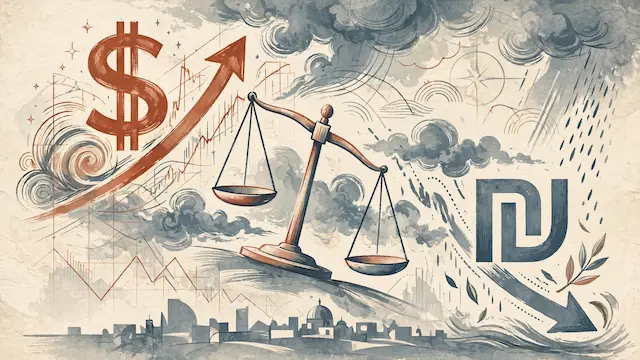
The Israeli shekel weakened significantly against the US dollar on Tuesday, with the dollar briefly reaching 3.22 shekels, a level not seen since December. This surge is attributed to a global trend of market declines, particularly the sharp 4-5% drop on Wall Street the previous day. Experts explain that a downturn in US markets prompts the transfer of dollars abroad for collateral, increasing demand for the dollar against the shekel. This dynamic offers a natural hedge for Israeli investors exposed to the dollar, as a strengthening dollar can offset losses in their portfolios during global market slumps.
Beyond international market volatility, domestic political uncertainty in Israel is also contributing to the shekel's weakness. The prolonged period of indecision regarding government formation following recent elections has heightened investor concerns. Additionally, the results of the US midterm elections, which reportedly showed increased animosity towards Israel and led to premature cessation of US aid, have further impacted the shekel. The widening interest rate gap between the shekel and the dollar also fuels demand for the dollar in the local market.
Israel's risk premium has reportedly increased, with analysts citing a "erosion of Israel's standing in the US" alongside the domestic election outcomes. Specific factors include former President Trump's announcement on election day about canceling security aid and Vice President Vance's statements against Israel post-election. The fear of further elections in Israel has exacerbated these concerns, making the shekel the world's worst-performing currency against the dollar since the election results were announced.
Despite the immediate concerns, the immediate impact of the US aid cancellation is considered manageable, given its small percentage of Israel's GDP and the strength of the high-tech sector and private consumption. However, the future government faces the challenge of Israel's declining global standing. The potential expansion of the Abraham Accords with Saudi Arabia is seen as a significant opportunity to bolster the Israeli economy and the shekel's value, potentially improving Israel's international image.
Local market conditions also reflect this uncertainty, with the Tel Aviv Stock Exchange's main index (TASE 125) erasing its gains for the year and returning to early-year levels. Global market declines, particularly in the chip, AI, and technology sectors, driven by concerns over massive capital expenditures, are also strengthening the dollar. A potential stabilization in global markets could ease pressure on the dollar-shekel exchange rate, but a clear resolution to Israel's political uncertainty is seen as a key factor for local market calm and investor confidence.
Mentioned



