
Israel, Greece, Cyprus Meet on Eastern Mediterranean Security Amid Turkey-Libya Deal Tensions
Translated & summarized from i24NEWS Arabic by baba
Israel, Greece, and Cyprus held a trilateral security meeting in Athens to enhance cooperation and counter regional challenges, particularly in response to the Turkey-Libya maritime deal. The nations discussed bolstering defense industries, protecting maritime routes, and combating terrorism. They reiterated their rejection of unilateral maritime claims and affirmed support for Cyprus's sovereignty, emphasizing international law and shared interests for regional stability.
The story in 5 lines · by baba
- Israel, Greece, and Cyprus met in Athens to boost security cooperation amid Turkey-Libya maritime deal tensions.
- The trilateral meeting focused on enhancing defense industries, protecting maritime routes, and countering regional threats.
- The three nations rejected unilateral maritime claims and affirmed support for Cyprus's sovereignty.
- They stressed the importance of international law and cooperation for stability in the Eastern Mediterranean.
- The meeting also addressed energy security and freedom of navigation in the region.
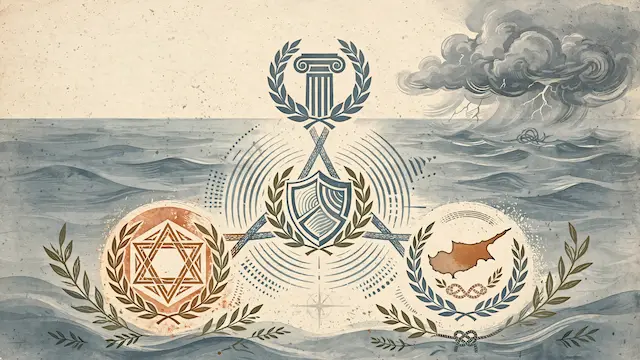
Defense ministries from Israel, Greece, and Cyprus held a trilateral meeting in Athens to bolster security and military cooperation and address shared challenges in the Eastern Mediterranean. The gathering, attended by heads of security policy departments and senior officials, underscores a strategic alignment among the three nations amidst escalating disputes over maritime rights and the Turkey-Libya maritime demarcation agreement.
Israeli Defense Ministry officials emphasized that security cooperation is a cornerstone of the trilateral partnership, referencing a joint declaration from a December 2025 summit in Jerusalem. The countries extended an invitation to other nations with similar perspectives to join their cooperative framework, aiming to expand collaboration and coordination in the region.
The discussions covered regional security developments, expanding defense industry cooperation, fostering military innovation and technology, and safeguarding vital maritime routes and strategic infrastructure. Officials explored practical project implementation through expertise exchange, joint initiatives, and regular dialogue. They also discussed opportunities for joint development, production, and technological cooperation, including the potential for a dedicated trilateral defense industry working group.
Topics also included disaster preparedness, civil protection enhancement, and improved coordination against emerging security threats. A joint statement stressed the need for cooperation to counter terrorism, advanced weapons proliferation, and destabilizing activities by state and non-state actors in the Eastern Mediterranean.
The three nations reiterated their rejection of unilateral claims, threats of force, and military actions that destabilize the region, emphasizing adherence to international law and the law of the sea regarding maritime rights and jurisdiction. They specifically addressed the Turkey-Libya memorandum of understanding on maritime jurisdiction, signed by the Libyan parliament on October 20, 2026. Israel, Greece, and Cyprus consider this agreement to infringe on other nations' sovereign rights and disregard international rules, asserting it has no legal effect on third parties.
Furthermore, Israel, Greece, and Cyprus reaffirmed their support for the sovereignty, independence, and territorial integrity of the Republic of Cyprus, aligning with UN Security Council resolutions and international law. They also rejected the use of any regional territory for activities threatening regional security.
Regarding energy, the countries highlighted cooperation as vital for regional stability and resilience, opposing any attempts to disrupt energy cooperation projects that violate international law. They underscored the importance of freedom of navigation and the protection of critical infrastructure and energy supply lines for the prosperity of Europe, the Eastern Mediterranean, and the Middle East.
The trilateral partnership was characterized as being based on shared democratic values and integrated strategic interests, serving as a framework for political and security coordination and strengthening ties between Europe and the Middle East. The participants concluded that dialogue, cooperation, and respect for international law are fundamental for the region's future.
Mentioned






