
Dollar Surges, Markets Plunge Amid Global Sell-Off
Translated & summarized from Behadrei Haredim by baba
The Israeli shekel fell sharply against the dollar on Friday, trading at 3.21, amid global market declines. Tel Aviv's stock exchange was set to open lower after significant losses, with defense and tech stocks leading the drop. The turmoil follows steep falls on Wall Street, driven by investor fears over potential AI regulation and broader economic uncertainty. This instability has impacted markets worldwide, including in Asia.
The story in 5 lines · by baba
- The Israeli shekel dropped to 3.21 against the dollar on Friday due to global market turmoil.
- Tel Aviv's TA-35 index fell 3.7% and other major indices also saw significant losses.
- Defense stocks led the decline on the Tel Aviv Stock Exchange, dropping 7.1%.
- Wall Street experienced sharp drops, particularly in tech stocks, impacting global markets.
- Investor concerns over potential AI regulation and election outcomes are driving market volatility.
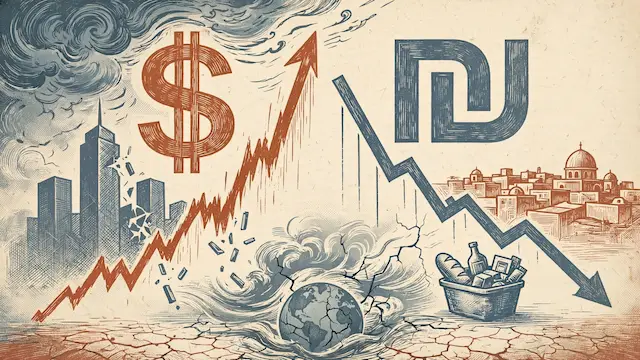
The Israeli shekel weakened significantly on Friday, with the dollar trading around 3.21 shekels, a sharp rise from the previous day's representative rate of 3.16. This surge is attributed to steep declines on Wall Street and other global stock markets. Market analysts explained that the downturns are compelling Israeli institutional investors to increase their dollar collateral and adjust hedging transactions, creating demand for hundreds of millions of dollars. Concurrently, exporters are capitalizing on the weaker shekel to sell foreign currency at relatively high rates.
The Tel Aviv Stock Exchange was expected to open on Friday following sharp losses the previous day. The TA-35 index dropped 3.7%, the TA-125 fell 3.4%, and the TA-90 weakened by 2.2%. Trading volume exceeded 19 billion shekels, partly due to periodic index rebalancing. The defense stocks index led the decline, plummeting 7.1%, followed by insurance at 5.1% and technology at 4.8%. Other sectors like finance, construction, and banking also saw decreases.
Dual-listed stocks, particularly chipmakers Tower and Camtek which fell on Wall Street, were anticipated to weigh on trading. Real estate and insurance stocks were also expected to be under scrutiny. These recent losses add to a period of instability in the local market since the Israeli elections, during which the TA-35 and TA-125 indices have lost approximately 9% of their value, while insurance and construction indices have fallen 18% and 17% respectively.
The current market turmoil originates from Wall Street, which closed Thursday with significant drops, especially in technology stocks. Investors are reportedly concerned that a Democratic victory in the US midterm elections could lead to stricter regulation of artificial intelligence. The Nasdaq composite index plunged 5.5%, its steepest intraday drop in 18 months, entering correction territory by falling over 10% from its peak. The S&P 500 and Dow Jones also experienced sharp declines, erasing previous day's gains that were fueled by falling oil prices and hopes of a swift end to the war in Iran following a political shift in Washington.
The US market downturn impacted Asian trading on Friday, with Japan's Nikkei index falling over 6%, South Korea's Kospi losing more than 5%, and stock exchanges in China, Hong Kong, and Australia also trading lower.
Mentioned
The same event, reported separately by each outlet. Open a few to compare what different newsrooms emphasize — and what they leave out.
Haredi 1Other 2


Not the same event — other stories that share this one’s people, places, or theme: background, reactions, and follow-ups.


