
Israeli Biologists Propose Ancient Brain Structures Generate Consciousness
Translated & summarized from Mignews by baba
Neurobiologists at the Hebrew University of Jerusalem theorize that ancient brainstem structures, not the cortex, generate subjective consciousness and the sense of self. They propose the brainstem performs the core calculations for awareness, with the cortex supplying information. This hypothesis is supported by observations of pain perception and coma induction, and researchers suggest testing it in specific brainstem regions.
The story in 5 lines · by baba
- Hebrew University of Jerusalem neurobiologists propose the brainstem generates consciousness, not the cortex.
- The theory suggests the cortex processes information, while the brainstem handles subjective experience.
- Pain perception's resilience to cortical damage supports the brainstem's role in consciousness.
- Damage to specific brainstem areas consistently leads to coma, unlike cortical damage.
- Researchers suggest testing the hypothesis in the mesopontine tegmentum region of the brainstem.
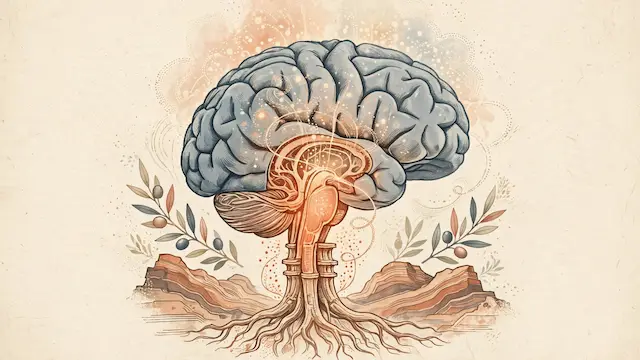
Neurobiologists from the Hebrew University of Jerusalem have put forth a new theory suggesting that ancient structures within the brainstem, rather than the cerebral cortex, are responsible for generating subjective human experience and the sense of self. The hypothesis, published in The Neuroscientist, posits that the brainstem handles the fundamental calculations for consciousness, while the cortex primarily processes and delivers information to it.
Researchers argue that the experience of pain, unlike senses like sight or hearing, is less dependent on the cortex. While extensive cortical damage can impair vision and hearing, pain perception often remains or even intensifies. Conversely, damage to specific brainstem areas consistently leads to coma, whereas cortical damage rarely causes a loss of consciousness.
According to the theory, the brainstem's neural circuits determine which information streams enter conscious awareness. The cortex, in this model, functions like an advanced driver in an autonomous vehicle, recognizing faces, understanding speech, and assessing risks, but it does not originate the conscious experience itself.
An evolutionary perspective supports this idea, suggesting that the capacity for subjective experience, like feeling pain, evolved in ancient structures as an enhancement to basic reflexes. When the cortex developed, evolution adapted the existing brainstem mechanism for consciousness rather than creating a new one.
The scientists propose that their hypothesis can be tested by examining the mesopontine tegmentum, a brainstem region linked to coma and unconsciousness under anesthesia.
The same event, reported separately by each outlet. Open a few to compare what different newsrooms emphasize — and what they leave out.
Other 2
