
Arab Citizens Face Israeli Discrimination Despite High Election Turnout
Translated & summarized from Alarab by baba
Arab citizens in Israel are facing discrimination despite an 80% election turnout and winning 19 Knesset seats, with key opposition parties refusing to partner with them. This has exposed a contradiction between Israel's democratic image and its exclusionary practices, according to the article. Israeli figures like Ilan Pappe and Michael Milstein highlight the systemic nature of the problem and its potential damage to Israel's international standing. The author urges Arab parties and voters to use this moment to expose discrimination and strengthen their own institutions, rather than accepting exclusionary agreements.
The story in 6 lines · by baba
- Arab citizens in Israel face discrimination despite 80% election turnout and 19 Knesset seats.
- Key opposition parties refuse to partner with Arab representatives, exposing Israeli exclusion.
- Historian Ilan Pappe states Israel is not a "democratic state in the strict sense."
- Researcher Michael Milstein warns of irreparable damage to Israel's global image from racism.
- The article contrasts Israel's treatment of Arab citizens with Western nations' inclusion of minorities.
- Arab parties and voters are urged to expose discrimination and strengthen their institutions.
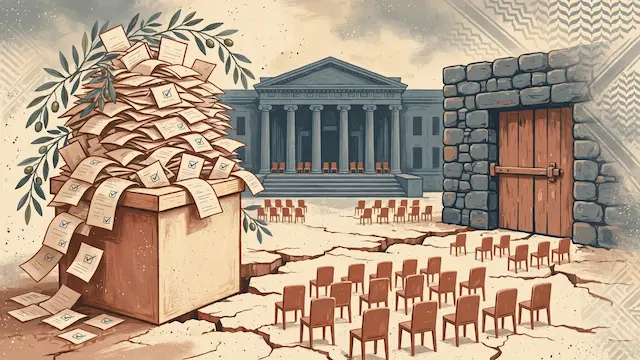
Following recent elections, Arab citizens in Israel are facing a stark contradiction: high participation rates and increased parliamentary representation have been met with skepticism regarding the legitimacy of their votes and a refusal by key opposition parties to partner with them. This situation has exposed what the article describes as Israel's attempt to use Arab participation to "whitewash" its image as a democracy while continuing to practice exclusion and discrimination.
The Knesset, as a pillar of the Zionist project, is seen as serving to strengthen the state's Jewish character. The presence of Arab members has historically been used to showcase Israeli democracy, masking deeper issues of land, identity, collective rights, and political influence. However, the recent election results, with nearly 80% Arab voter turnout and Arab lists securing 19 seats, have intensified doubts about the validity of Arab votes and highlighted the gap between allowing Arabs to vote and accepting their influence in government formation.
Israeli historian Ilan Pappe is quoted stating that "Israel is not a democratic state in the strict sense," arguing that the exclusion of Palestinian members from government formation calculations reveals the limits of recognizing them as legitimate political partners. Similarly, Israeli researcher Michael Milstein warns that attacks on Arab votes and rising racism against Arab citizens could cause irreparable damage to Israel's global image, beyond what "good propaganda" can fix.
The article contrasts Israel's treatment of its Arab citizens with that of Western countries like the UK and Germany, where individuals of immigrant backgrounds have reached high political office, such as Sadiq Khan becoming Mayor of London and Aydan Özoguz serving as Deputy Speaker of the Bundestag. It argues that Palestinian citizens of Israel, as an indigenous population, are being treated more restrictively than immigrant minorities in Western nations.
The author contends that the responsibility now lies with Arab voters and participating parties to leverage this moment. Instead of celebrating seat numbers, they should engage in organized political and media efforts to document incitement, expose the discrepancy between Israeli propaganda and reality to the international public, and strengthen their own national institutions. The article warns against accepting temporary agreements that allow for continued exclusion and calls for a unified approach to confront racism and discrimination, regardless of differing stances on election participation.
Mentioned


